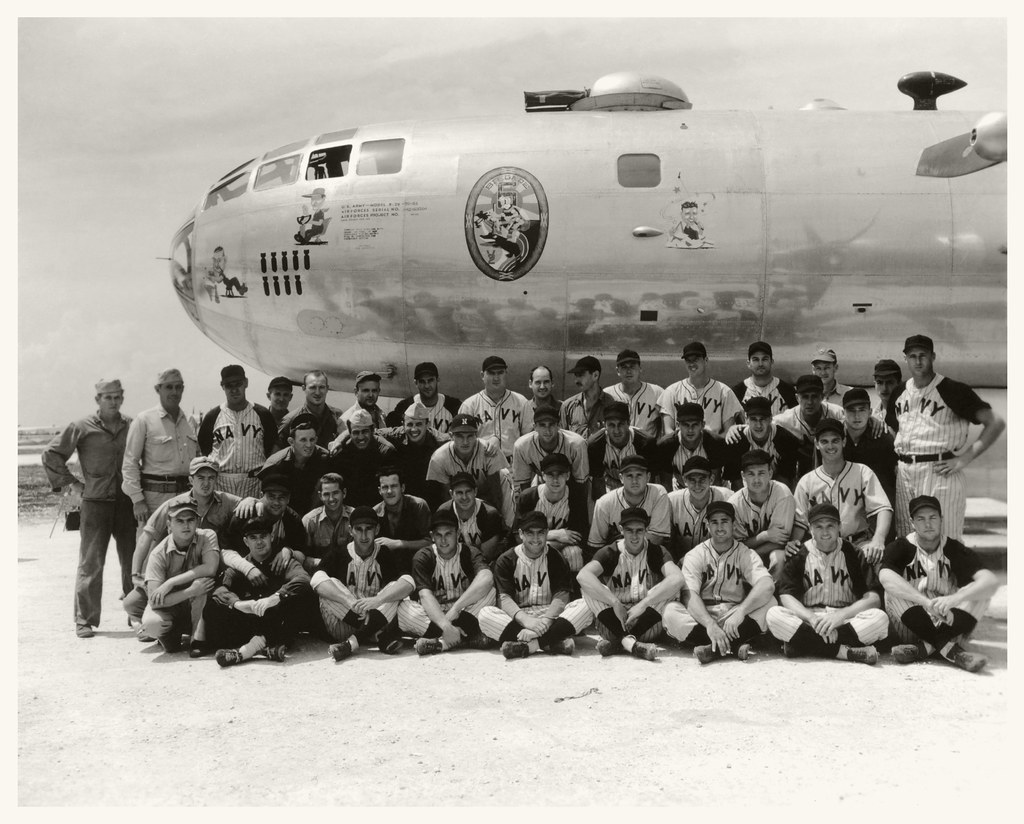
Despite the visual information present in vintage baseball photographs, many details often remain shrouded in mystery as decades pass. Memories fade and the subjects in the images pass and fade away leaving behind unnamed faces. A recent arrival to the Chevrons and Diamonds Collection fits the aforementioned bill. The photo shows Navy baseball players posed alongside a B-29 heavy bomber.

Pictured are:
Fourth Row: Crewman, Crewman, Mace Brown, Crewman, Crewman, 2nd Lt. Albert R. Naswich, Vinnie Smith, Johnny Mize, crewman, 2nd Lt. Roy W. Adams, Tom Ferrick, George Dickey, Mike Budnick. Capt. Wayne A. Gustafson, Crewman
Third Row: Crewman, Freddie Apostoli, Georgie Abrams, Red McQuillen, Mickey Vernon, Johnny Rigney, Barney McCosky, Buddy Blattner, Johnny Vander Meer, Crewman, Joe Grace
Second Row: Crewman, Johnny Lucadello, Bobby Riggs, Connie Ryan, Jim Trexler, Pee Wee Reese, Virgil Trucks, Del Ennis, Bob Klinger, Albie Glossop
Front row: Crewman, Miller (Umpire in black uniform), Bennie Huffman, Gene Woodling, Frank Marino, Hal White, Al Brancato, Merrill May, Elbie Fletcher
(Chevrons and Diamonds Collection)
The verso of the photograph sheds light on some of the men depicted in the image, however questions remain:
- Where was the photo taken?
- Who are the unnamed men?
- What is the significance of the bomber aircraft?
- Why does the bomber have a Navy Seabee insignia painted on its nose?
On the heels of the conclusion of the 1944 Service World Series on Oahu in the territory of Hawaii, the Navy organized a road show to take the former professional ballplayers on a tour of the Pacific Theater, sharing the game with GIs stationed on islands secured by American Forces. In early 1945, twenty-eight players divided into two teams departed Hawaii for Johnson Atoll beginning a multi-stop campaign, representing the Third and Fifth Fleets. In addition to the ballplayers, two former professional boxers and a star tennis player were part of the tour, staging pugilistic exhibitions and table-tennis contests.
1945 Navy Pacific Baseball Tour Stops:
- Central / North Pacific: Johnston Atoll
- Marshall Islands: Majuro, Kwajalein, and Roi
- Caroline Islands: Angaur, Peleliu and Ulithi
- Northern Mariana Islands: Guam, Saipan, and Tinian
When the tour reached the Marianas—Guam, Saipan, and Tinian—the players entered a region rapidly being transformed into the principal forward base for the B-29 offensive against Japan.
All three Northern Marianas Islands were of vital strategic importance due to their proximity of the Japanese homeland and had seen ferocious battles in order for the U.S. forces to gain control. After each was captured, massive airfields and airbases were constructed by the Navy’s construction battalions (“See Bees”) moving tons of earth and laying thousands of tons of perforated steel planking known as Marsden matting for the lengthy runways needed for the U.S. Army Air Forces heavy bombers.
Saipan was wrested from Japanese forces on July 9, 1944, following a 24-day battle with the first B-29, “Joltin’ Josie, The Pacific Pioneer,” touching down on October 12 at Isley Field. Guam, secured from enemy forces on August 10, 1944, received its first B-29s on November 24.[1]

Tinian, the island that lay five miles southwest of Saipan, was declared secured on August 1, 1944, with airfield construction commencing shortly after with the first B-29 of the 482nd Bomb Squadron touching down on December 21. Following training missions, the 482nd entered the fight with its first mission on January 24, 1945.
The operational pace on the island of the 20th Air Force was intense when the Navy ballplayers arrived. In between missions, the Third and Fifth Fleet teams provided respite playing games for the benefit of the troops.
1945 Pacific Tour – Third Fleet Roster:
| Player | Position | Former |
|---|---|---|
| Player | Position | Former |
| Buddy Blattner | 2B | Cardinals |
| Mace Brown | P | Red Sox |
| Mike Budnick | LF | Seattle (PCL) |
| Elbie Fletcher | 1B | Pirates |
| Joseph “Joe” Grace | RF | Browns |
| Johnny Lucadello | 2B | Browns |
| Merrill “Pinky” May | 3B | Phillies |
| Barney McCosky | CF | Tigers |
| Harold “Pee Wee” Reese | SS | Dodgers |
| Johnny Rigney | P | White Sox |
| Cornelius “Connie” Ryan | 3B | Braves |
| Vincent Smith | C | Pirates |
| Jim Trexler | P | Indianapolis (AA) |
| Hal White | P | Tigers |
1945 Pacific Tour – Fifth Fleet Roster:
| Player | Position | Former |
|---|---|---|
| Albert (Al) Brancato | SS | Athletics |
| George “Skeets” Dickey | C | White Sox |
| Del Ennis | LF | Trenton (ISLG) |
| Tom Ferrick | P | Indians |
| Al Glossop | SS | Dodgers |
| Benny Huffman | LF | San Antonio (TL) |
| Bob Klinger | P | Pirates |
| Frank Marino | P | Tulsa (TL) |
| Glenn “Red” McQuillen | CF | Browns |
| Johnny Mize | 1B | Giants |
| Virgil Trucks | P | Tigers |
| Johnny Vander Meer | P | Reds |
| Mickey Vernon | RF | Senators |
| Gene Woodling | CF | Indians |
In addition to the baseball teams playing games, boxers Georgie Abrams and Fred Apostoli staged pugilistic exhibitions. Tennis star Bobby Riggs faced Buddy Blattner in table tennis for the benefit of the troops.
A seldom seen photograph shows the Navy players lined up and posed in front of a B-29 with unusual nose art. In addition to the Navy contingent, USAAF personnel are posed with the athletes. Upon close examination of the art painted upon the fuselage is atypical of that of other aircraft in the 20th Air Force. The main illustration features a caricature of a bee wearing a white dixie cup cap holding tools and weapons in its four hands and standing atop an alligator stepping onto the beach from the sea. An aircraft of the U.S. Army Air Forces paying homage to the Navy? There had to be a reasonable answer to the question of its presence on the aircraft.
This photograph, a recent acquisition for the Chevrons and Diamonds Collection, originates from the personal collection of former Philadelphia Athletics shortstop and Navy ballplayer, Al Brancato, who is among the men in the image. On the verso of the print, Brancato inscribed the names of the athletes identifying them in their position within the group. Among the athletes are unidentified airmen and other military personnel.

Also visible in our image is the stenciled build details including the U.S. Army – Model (“B-29-26-BA”), the Air Forces Serial Number (“-12-63504”), Air Forces Project No. (“98109”), and the maximum crew weight (“1,200 LBS”). These details reveal the B-29’s nickname as “Flag Ship,” enabling further research and revealing the identities of the assigned flight crew.

The mystery surrounding the B-29’s nose art was soon solved when we shared the photo with a colleague and fellow military historian. He recently acquired a large group of WWII Navy prints numbering over 1,000 and within that group was a photo of four Army Air Force officers posed beside a B-29, specifically at the nose art.

The caption on the verso reads:
“April 4, 1945 – Tinian: In gratitude to the Sixth Naval Construction Brigade for building the immense airfield used by Superfortresses of the 21st Bomber Command on Tinian in the Marianas, crews of the B-29s agreed to allow the Seabees to sponsor their giant charges. As a result, the planes are now known as ‘Seabee29s’, and bear on their noses the insignia painted by the various battalions in the brigade.
Flight officers smilingly pose beside the Seabee Sixth Brigade insignia on their bomber. In the group are (left to right), Second Lieutenant Albert R. Naswich, bombardier; Second Lieutenant Roy W. Adams, co-pilot; Second Lieutenant Harold G. Gurish, Navigator; and Captain Wayne A. Gustafson, Pilot and Aircraft Commander.”
Aircrew of Flag Ship, early 1945[2]:
| Rank | Name | Service # |
|---|---|---|
| Capt. | Wayne A. Gustafson | 0420386 |
| 2d Lt | Roy W. Adams | 0822337 |
| 2d Lt | Albert R. Naswich | 02051251 |
| 2d Lt | Harold Gurish | 0710260 |
| T Sgt | Earl F. Gaede | 15052243 |
| Cpl | William H. Hunter | 38458048 |
| Cpl | Cecil V. Shaw, Jr. | 17090743 |
| Cpl | Robert H. (N?) Young | 32912974 |
| Cpl | Lester J. Roche | 31409772 |
| Cpl | Radford L. S. Dunaway | 34799307 |
| Cpl | William E. Ferguson | 13141738 |
The nose art was added to pay respects to the Seabees who constructed an airfield and facilities at lightspeed enabling the commencement of the massive air offensive operations from the island, beginning with the reconstruction of the existing Japanese airfield as the Tinian battle was underway.
Before and during the amphibious assault on Tinian, Japanese defenses were heavily damaged by naval gunfire and aerial bombing by carrier-based aircraft. The Japanese airstrip was devastated and rendered inoperable. After securing the airfield, the Navy’s Sixth Naval Construction Brigade (SeaBees) came ashore with orders to restore the airstrip. “At 7 a.m. on July 27, 1944, three days after the first assault waves hit the island, orders came from Saipan to repair the just-captured Jap (sic) airfield at Ushi Point for the evacuation of wounded.”[3]
The Seabees had their work cut out for them as the heavy fighting on the island continued. “The field then was so full of bomb craters a Piper Cub could not have landed there. With only eight trucks, nine bulldozers and two tandem rollers, augmented by hastily repaired Jap (sic) equipment, the Seabees had the field ready for the first plane less than 24 hours after the repair order was given.”[4]
Repairing heavy bomb damage to an existing runway is certainly a monumental accomplishment, but building an entire runway capable of handling bomb-laden B-29s is entirely different. The 6th Naval Construction Brigade spent a month-and-a-half building a new, 6,000-foot runway. Construction on the runway began September 25, and it was “put into use after only 45 days and nights of round the clock operations. Six thousand feet long, it involved the moving of a million cubic yards of coral and was built primarily for Navy patrol bombers and fighter planes.” Meanwhile, construction was also underway for three additional 8,500-foot runways on the North Field and two on the island’s West Field, effectively making Tinian the single largest airport in the world. By the war’s end, the Brigade constructed 53.6 miles of runways and taxiways on Tinian.

Recognizing the magnitude of the Seabees’ accomplishment led to a unique bond between the airmen and construction sailors. In return for the USAAF’s gratitude, the 6th Naval Construction Brigade adopted and sponsored “Flag Ship,” painting their unit insignia on the nose of the aircraft.[5] By the time the Navy ballplayers arrived on Tinian, the 482nd Bombing Squadron had conducted several combat missions and “Flag Ship” had participated in eight as indicated by the number of bomb silhouettes painted on the ship’s nose. It is clear that our baseball photo was captured on Flag Ship’s island base of Tinian.
The Third and Fifth Fleet photo from Al Brancato’s collection provides us with the identities of the athletes but leaves eleven of the pictured men unidentified. However, the photo of the four aircrew provided a means to identify three of the four among the athletes. Considering the Flag Ship’s full crew complement is eleven men, it is almost a guarantee that the eight remaining unidentified men are the other Flag Ship crew.
While the mysteries surrounding the nose art and the identification of the non-athletes in our photo may be solved, matching names to all of the faces is the ultimate objective that we hope to reach in the near future.
[1] Colin M. Colbourn, “The Key to the Central Pacific: The Capture and Strategic Development of the Mariana Islands by the United States in World War II,” NOAA Ocean Exploration, March 4, 2022.
[2] Morning Reports, U.S. Army, National Archives.
[3] Paul J. Halloran, Commodore, U.S.N. “Sixth Brigade Log,” U.S. Navy, 1945.
[4] Paul J. Halloran.
[5] Paul J. Halloran.

Leave a Reply