Building a competitive edge through the acquisition of superior talent has been the mark of championship baseball teams for more than 150 years. For competitive clubs on the verge of a title, bringing in a star player is all that it takes to push the club to the pinnacle of success. After being swept by the Arizona Diamondbacks in the 2023 National League Division Series, the reigning National League West champion, the Los Angeles Dodgers, landed the biggest name in the game, Shohei Ohtani, who led the team to consecutive World Series titles in the next two seasons.
More than a century earlier, on January 5, 1920, the New York Yankees made an announcement that shaped baseball for a long time. Boston Red Sox owner Harry Frazee sold one of the game’s biggest stars, George Herman “Babe” Ruth, to the Yankees, their American League rival. The deal sent the two clubs in sharply different directions. Over the next 16 seasons, Boston became a perennial American League cellar dweller. Despite capturing pennants in 1946, 1967, 1975, and 1986, the Red Sox failed to capture a World Series Championship until 2004, their first since 1918, when Ruth starred for the club.
For the Yankees, the sale signaled their commitment to build a championship team and despite falling four games short of the 1920 pennant, the Bronx club would go on to the capture the flag for the following three consecutive seasons including the team’s first world championship in 1923. The Yankees’ success continued as the team parlayed their winnings into gathering and developing talent from across the country, leading up to their fourth pennant in 1926 and a World Series against the St. Louis Cardinals, the first of five such matchups in the two clubs’ histories.
The Yankee leadership continued their relentless talent-sourcing as they built their team for both the near and long term. While the Yankee roster was loaded with talent by the mid-1920s, its core offense, consisting of Babe Ruth, Bob Meusel (who, like Ruth, arrived in York for the 1920 season), Lou Gehrig (1923), Earle Combs (1924), Mark Koenig (1925), and Tony Lazzeri (1926), earned the nickname of “Murderer’s Row” due to their dominant hitting. Assembling a major league roster in the 1920s required a combination of a committed ownership, talent assessment (scouting), financial resources and a will to make trades. Assembling a winning team required the best of all four, combined with solid management both on the field and in the front office. The Yankees had it all.
Fleet Baseball
At the beginning of the twentieth century, intraservice athletic competition was a prominent means to promote esprit-de-corps and physical fitness. In the U.S. Navy, most ships’ crews participated in one or more forms of team and individual athletic competitions including track and field, swimming, boxing, football and whaleboat pulling races. Baseball was established as the premier team sport.
While baseball was the crown jewel of Navy athletics and capturing the overall championship was highly coveted, the ultimate goal for each ship was to accumulate the most overall points from all sports.
For the Pacific Fleet, the year-long competition across all of the athletic disciplines was tracked through wins and losses, divisional standings and ultimately divisional championships. Points were awarded for each divisional athletic discipline’s first, second, and third place ship team.[1] The objective was to capture the coveted Navy Department General Excellency Trophy for Capital Ships of the Pacific Fleet, better known as “The Iron Man Trophy.”[2]
After the USS Mississippi (BB-41) captured the first trophy in 1919, her crew successfully defended it for four additional years. Rising to the challenge, the men of the USS California (BB-44) unseated the five-year champions, laying hold of the Iron Man in 1924 and maintaining its grip in1925.[3] When Captain William H. Standley took command of the ship on February 15, 1926,[4] the USS California was well on her way to securing the Iron Man for a third consecutive year but his baseball team, while strong in their division, did not dominate. As the season wound down, teams from USS New Mexico (BB-40) and USS Idaho (BB-42) were sitting atop the twelve-team Battle Fleet standings as both clubs were undefeated.[5]
When the post-season was over, the New Mexico was standing on the U.S. Fleet Baseball Championship mountain, having defeated the Fleet Air Force team from North Island Naval Air Station.[6] Ultimately, the USS California’s less than stellar performance in the tournament did not set them back in their quest to retain the Iron Man Trophy for 1926; however, being spectators at the U.S. Fleet Championship left the men of the “Prune Barge” hungry for diamond greatness.

As the U.S. Fleet’s spring championship tournament was taking place at the Balboa ballfield in the Panama Canal Zone, the Coco Solo Submarine Base nine was busy dominating the Army and Navy and city leagues on the opposite side of the isthmus. One of their players was attracting attention.
The Navy’s “Flying Dutchman”
From 1921 until April 1924, Henry A. “Dutch” Raffeis, a torpedoman chief petty officer, was stationed on submarines assigned to the Coco Solo Naval Base on the Atlantic Ocean side of the Panama Canal Zone. Born in Toledo, Ohio and raised in the Oklahoma Territory, Raffeis had been serving in the Navy since 1915 and had built a considerable reputation as a baseball player since he first enlisted. Having served predominantly in the Navy’s silent service with duty on submarines or submarine tenders and having drawn comparisons to the Pittsburgh Pirates shortstop great, John Peter “Honus” Wagner, from his contemporaries and local sportswriters, “Dutch” Raffeis was known for his ability to get on base, a fantastic glove in the middle infield and a cannon for an arm. The Navy’s “Flying Dutchman” seemingly willed his teams to championships with his defense and offense from the moment he donned flannel for the U.S. Navy. He led his aggregation to a title in the 1915 Panama–Pacific International Exposition baseball tournament. From 1920 to 1926, Raffeis-led teams captured crowns in 1920 (San Pedro Submarine Base); 1921 (San Pedro Merchants) and four consecutive championships in the Canal Zone’s Army and Navy League in 1923, 1924, 1925 and1926 with the Coco Solo Submarine Base.

As Raffeis was leading his Coco Solo-based team to the 1926 Army and Navy League and City League championships in the Panama Canal Zone, the Battle Fleet and Scouting Fleet baseball competitions were winnowing down to determine their representatives for the overall U.S. Fleet championship series. By late March, the battleships West Virginia and California were the cream rising to the top as the Maryland and the Pennsylvania fell at their respective hands.[7]
Naval ship baseball team coaches, unlike professionals, were left to build their teams from the ranks of men serving aboard their ship. It was a stroke of fortune should a ship find exceptionally talented ballplayers serving aboard it. Larger vessels such as battleships, cruisers and aircraft carriers featured sizable crew complements, increasing the pool of talent from which to assemble a competitive squad.[8] There were no scouts or general managers acquiring and aggregating talent onto rosters of Navy teams. What about free agency?


Free Agency in Military Baseball
Dutch Raffeis’ diamond prowess caught the attention of big-league clubs. He was scouted by the Chicago Cubs in the early 1920s, receiving an invitation to participate in their first spring training held on Southern California’s Catalina Island. He left that 1922 camp with an offer to play professionally but preferred to continue his naval career aboard ships and play on Navy diamonds.
As he furthered his Navy playing career, the chief torpedoman was no stranger to sportswriters. “Rafaes [sic] has a contract in his possession, which he constantly refuses to sign, to play with the Chicago Cubs. He is one of the greatest third basemen the Navy has yet developed, and this accounts for the fact that the Coco Solo baseball team has won the Army and Navy Championship of the Panama area for the past five years. Rafaes is a chief torpedoman and is figuring on retiring from the Navy when he has sixteen years’ service. With a fat pension coming in every month, he can still go out and hold a berth in some baseball league.”[9]

The Ringer’s Odyssey
Stationed aboard the “S” class submarine USS-S-49 since July 31, 1926, Chief Raffeis was honorably discharged from the Navy on November 8, having served 11 years, 9 months and 25 days.[10] Now a civilian, Dutch was transferred off the boat and returned to the States, setting off a most unusual chain of events and correspondence.

A message was dispatched that same day, November 8, 1926, from the USS California, in port at the Puget Sound Navy Yard in Bremerton, Washington, to the Bureau of Navigation (BuNav), the arm of the Navy responsible for the management of all enlisted personnel. It requested permission for the Navy Recruiting Office in Columbus, Ohio to reenlist Raffeis specifically for duty aboard the battleship.
After departing Coco Solo, Raffeis returned to the United States, but his port of entry is unknown. It is apparent that Chief Raffeis’ travel and initial destination was part of a plan that was not documented in his service record. If he simply reenlisted while still aboard the S-49, his duty assignment was at the mercy of the Bureau of Navigation, the governing entity that had authority over enlisted personnel and their duty assignments. If Raffeis was under orders, travel to his next duty station would have been documented with the orders and transfer details in his service record. Once he disembarked from the transport vessel as a civilian in a U.S. port, his movement was at his discretion. The unusual November 8 message from the California indicated an off-the-record plan was afoot.
In the time it took for him to travel from the Canal Zone to the States and then make his way via train to Ohio, Dutch arrived in Cincinnati, appearing to have stopped short of his planned destination of Columbus. A week after he departed the S-49, the U.S. Navy Recruiting Station in Cincinnati dispatched a message via the U.S. Naval Communication Service to the Bureau of Navigation, requesting the authority to transfer Chief Raffeis to the USS California for reenlistment on November 15.[11] A second message mirroring the U.S. Naval Communication Service communiqué was sent via the Signal Corps U.S. Army to BuNav.
The following day, the recruiting station received a response from BuNav that said “Impracticable (to) transfer Raffeis unless (he) reenlist(s) West of (the) Mississippi River.”[12][13] Raffeis was left to continue his journey at his own expense without reenlistment or orders. He arrived in Bremerton, Washington, one week after the BuNav message. Chief Torpedoman Henry Raffeis was sworn in aboard the U.S. Receiving Ship at the Puget Sound Navy Yard on November 22, 1926, ending his two-week stint as a civilian.[14] His ultimate destination, the battleship California, was at sea, requiring a coordinated effort to transfer Dutch to the ship.


With Raffeis back into the fold of the Navy, getting him to the California should have been a simple operation. It was common for a sailor under orders to be placed aboard another ship as a passenger for further transfer to his ultimate destination. Two days after Raffeis resumed his naval career, a U.S. Battle Fleet message was dispatched on November 24 from the USS California to BuNav, requesting that Raffeis’ transfer to the ship be expedited.[15] On November 26, BuNav replied with a message both to the USS California and the Navy Recruiting Station, St. Louis, ordering Raffeis to be transferred to the battleship.[16]
Raffes’ transfer to the USS California from Puget Sound Navy Yard was set in motion on December 16 when he departed Bremerton aboard the battleship USS Arizona as a passenger designated for further transfer.[17] While at sea, Chief Raffeis was transferred to the battleship USS Maryland on December 22.[18]
As we researched Chief Raffeis’ lengthy process to reach and serve aboard the California, the question emerged as to how the brass at the Bureau of Navigation and aboard the California addressed the absence of a torpedo armament and subsequently, a torpedoman billet for the vessel. Raffeis, a career submariner and rated torpedoman, seemingly had no business serving aboard the ship and yet there was a significant effort expended by multiple parties to get him there. After serving his first two years as a seaman, Raffeis was rated a gunner’s mate third class in 1917. Raffeis’ proficiency marks and wartime service in his rate led to his rapid advancement as he attained his chief petty officer anchor in November 1918, three years after he enlisted.[19] Following the establishment of the Torpedoman rating in 1921, Raffeis’ rating was changed from chief gunner’s mate to chief torpedoman the following year.[20] His experience as a gunner’s mate was brief and exclusively aboard submarines, which meant that he lacked the credentials for battleship service.

The day after Raffeis was transferred to the USS Maryland, Commander Charles S. Joyce, the California’s executive officer, dispatched a letter to Lieutenant Commander Robert B. Carney, aide to Admiral Louis R. de Steiguer, who was the Commander Battleship Division Four, Battle Fleet, aboard the USS New Mexico. Admiral de Steiguer was in charge of three battleships including the USS Maryland, where Chief Raffeis was currently attached. The letter shed light upon the reason for Raffeis’ assignment to the California and the urgency to complete his transfer to the “Prune Barge.”[21]
The letter to Carney detailed Raffeis’ transit and reenlistment ordeal that took him across the country at his own expense. Commander Joyce emphasized, “He [Raffeis] is a ballplayer, but in addition, there is a chance of our Chief Torpedoman going to the Brazilian Mission[22] and we will need him then anyhow.” Joyce also called attention to the lengthy delay in getting Raffeis to the ship, “Through some carlessness [sic] on the part of Receivingship [sic] at Puget Sound (probably), his destination has been lost sight of,” Joyce wrote, “and we find that he was transferred yesterday from the ARIZONA to the MARYLAND.”[23]


Taken together, the correspondence and related actions strongly suggest that Captain Standley and his executive officer were intent on acquiring a baseball ringer—much as a contemporary major league owner and general manager might pursue talent for their club. With his November 8 discharge, Raffeis became a free agent and worked to facilitate a move to a position on a championship team.
The USS California’s urgency in attempting to bring Raffeis aboard continued to build. An unsigned letter (likely from Commander Joyce), written on Christmas Day, was sent to the executive officer of the USS Maryland and underscored the need to get him aboard the ship. The letter also made clear who the author of the transfer plan to the USS California was. “Raffeis is a ballplayer and, no doubt, his idea in coming here was to join our team.”[24] A second letter from Joyce was sent on behalf of Captain Standley to Admiral Charles F. Hughes, the Battle Fleet Commander-in-Chief, detailing Raffeis’ situation and requesting his transfer.[25]
Nearly three weeks later, Chief Raffeis was finally transferred to and received aboard the USS California.[26] Meanwhile, the Battle Fleet baseball season had gotten underway on January 3 with a series of games played by teams from the battleships West Virginia, Oklahoma, California, Idaho, Mississippi, New Mexico, Pennsylvania, West Virginia, Tennessee, Arizona, Colorado and Nevada at Naval Operating Base San Pedro’s Trona Field.[27]
Enter the Ringer
With the USS California “Bears” dominating the competition, it appeared that the ship’s team was once again a serious contender. By early February, the Bears were leading the battleship divisions in the race for the Battle Fleet championship along with teams from the Pennsylvania and Idaho.[28]
Rain postponed the Pacific Fleet championship, scheduled to be played in San Diego in mid-February. With the fleet operating in the Pacific off South America, the Battle Fleet championship was rescheduled for March in the Panama Canal Zone.[29] The best-of-three series pitted the California against the Fleet Air squad. The California took the first game in a 3-0 shutout but dropped the second in an 11-7 slugfest.[30]
On March 7, the Prune Barge captured the Pacific Fleet crown in the final game at Balboa, downing Fleet Air 8-5. It earned the right to play in the United States Fleet championship series at Guantanamo Bay, Cuba, representing the Battle Fleet.[31]
Ahead of the final championship series, the addition of Chief Raffeis to the California’s roster was proving to be a resounding success. However, ahead of the Guantanamo Bay tilts, an issue arose regarding Raffeis’ eligibility. Perhaps prompted by a competitor’s challenge questioning Raffeis’ presence on the Bears’ roster, rule 11 of the U.S. Battle Fleet Athletic Rules, 1926, stated, “No person shall compete in any Battle Fleet athletic event who has not been regularly attached to the ship of subdivision which he represents for at least six weeks prior to the date of the contest.”[32]
Based upon Raffeis’ January 11 date, he was ineligible to participate in any Battle Fleet sanctioned event until March 10. This meant that enforcement of the rule could have negated all of the California’s victories and stripped the team of its Battle Fleet crown and removed them from the U.S. Fleet championship. On March 27, Admiral Hughes reviewed the situation and sent a letter to Captain Standley, ruling on Raffeis’ eligibility question. Admiral Hughes stated, “From the perusal of copies of official documents pertaining to the re-enlistment, orders and reporting of Henry Raffeis, C.T.M., U.S.N., on board the California, it appears that the failure of Raffeis to report for duty on the California at an earlier date than 11 January, 1927, was due to non-compliance or misinterpretation of instructions of the Bureau of Navigation, and was through no fault of the California or Raffeis.”[33]
Admiral Hughes concluded, “In view of the above, and the efforts of both Raffeis and the California to effect the re-enlistment of Raffeis on the California during November 1926, and in view of the Bureau of Navigation’s actions thereon, the Commander-in-Chief, U. S. Fleet, considers that within the interpretation of the U.S. Fleet Athletic Rules, Raffeis is available to take part in the U.S. Fleet Baseball Series scheduled to commence April 6, 1927.”[34]
Ship commanders such as the USS Maryland’s Captain Thomas T. Craven had teams competing in the tournament and for the Iron Man Trophy. They possessed insight into Raffeis’ transfer ordeal and the timing of his arrival aboard the California and they may have been responsible for submitting inquiries to Admiral Hughes challenging his eligibility and prompting the ruling in a written response. Admiral Hughes’ letter could have been preemptive in nature, heading off any potential for issues rather than a response to gamesmanship.


Following the March 1927 naval exercises, the combined fleets arrived at Guantanamo Bay, dropping anchor off Deer Point, close to the naval facilities. Situated on a plain within a few hundred yards of the fleet landing, Guantanamo Bay’s ballpark had grown within a few decades from a sandlot on the site at the turn of the century to a sizable facility replete with grandstands with concessions that accommodated a few thousand spectators. A century later, the site is home to the base’s physical fitness center, ball fields, and a go-cart track, spanning a significantly wider footprint.

U.S. Fleet Championship Series
Representing the Atlantic Navy in the U.S. Fleet baseball championship tournament was a team from the USS Wright (AZ-1). The Wright, commissioned in 1921, was designed as a troopship but repurposed during construction to be used as a tender to service lighter-than-air and heavier-than-air aircraft. By 1927, with naval aviation’s rapid technological advancement, the tender exclusively serviced the Navy’s seaplane aircraft. Her commanding officer was Captain Frederick J. Horne, who was a member of the first class of captains to undergo and complete flight training at Pensacola, earning his “wings of gold” as a naval aviation observer.
Compared to the Battle Fleet, the scouting fleet’s size was comprised of fewer ships, which may have provided an easier, less-competitive path to the U.S. Fleet tournament. The Wright captured both the Aircraft Squadron and the Scouting Fleet titles by sweeping teams from the USS Dobbin (AD-3) and USS Florida (BB-30) in consecutive three-game series, earning its first trip to the winner-take-all tournament at Guantanamo Bay. The Wright and the California were set to compete for the U.S. fleet championship in a three-game series in three days, starting on April 8.
USS Wright Tournament Roster:
| Rank | Player | Position |
|---|---|---|
| AM1/c | Bradley | C |
| ACM/3c | Cuba | IF |
| BK3/c | Davis | LF |
| CDR | A.H. Douglas | P |
| AMM1/c | Drake | 1B |
| S1/c | Feirstein | OF |
| COX | Foran | 3B |
| CPhM | Johnson | C |
| BM1/c | Jones | CF |
| CQM | Lyons | OF |
| AMM1/c | Mang | IF |
| YN2/c | McAvoy | P |
| YN2/c | Mikeal | 2B |
| CSK | Nolan | P |
| COX | Steward | P |
| LT | P. C. Treadwell | UT/Coach |
| CSK | Waldrop | RF/P |
| AMM1/c | Welde | P |
In the first game, after each club scored in their respective halves of the first inning, the game was deadlocked through seven frames. In the eighth, Wright plated three to take a 4-1 lead, holding the advantage through the final inning. Wright batters outhit the Prune Barge seven to three while California doubled up their opponent in the error column with a pair of boots.

The second game on looked like a repeat of the first, from the opening frame through the third with a 1-1 tie. California’s offense awakened, with the team scoring a pair of unanswered runs in the fourth, fifth and seventh innings to take and hold a six-run-lead, which was their margin of victory. Wright batters connected for five hits and cleaned up their defense while the California team’s defensive woes continued with their third error of the series. California won the Game 2, April 9 contest, 7-1.
USS California Tournament Roster:
| Rank | Player | Position |
|---|---|---|
| Baker | CF | |
| Beveridge | RF/P | |
| “Pineapple” Biggs | C | |
| Cruger | SS | |
| Gable | C | |
| “Pops Griffith | P | |
| Hollis | LF | |
| Jaros | 1B | |
| “Pee Wee” Newhall | 2B | |
| CTM | Henry A. “Dutch” Raffeis | 3B |
With the series tied, the winner-take-all Game 3 was set. California’s bats had awakened and appeared to be primed to put down the lowly seaplane tender’s upstart ballclub. Captain Standley had his ringer and was, no doubt, confident in the team’s impending victory.
Scoreless through the first two innings, each club scored a single run to keep the game tied at 1-1. The game stayed that way through the fifth inning and was shaping up to be a pitching duel. However, in the top of the sixth, Wright batters commenced an offensive barrage, scoring two unanswered runs. Again, in the seventh, the Wright tallied four more to extend their lead to 7-1. In the bottom of the frame, California batters tacked on a run of their own but that was the end of their offense for the game.
Adding insult to injury, the Wright added another pair of runs in the top of the ninth. Attacking California pitching, Wright clubbed 16 hits while the Prune Barge’s defense committed three errors. Thus, the Wright took the U.S. Fleet championship with a 9-2 embarrassment on the center stage of the Navy’s fleet athletic competition.[35][36]
For the California’s travails in landing their ringer, Chief Torpedoman Henry “Dutch” Raffeis, they were all for naught. Despite the loss, California amassed enough points to capture their third consecutive Iron Man Trophy. The 1927 fleet baseball crown was the first of several consecutive U.S. Fleet diamond titles for the Wright. With their naval exercises and athletic championship competitions complete, the California turned north up the Atlantic coast en route to New York from the port of Gonaives, Haiti.[37]
For California’s ringer, time aboard the battleship was running out short. Weeks after losing the championship, seeking to become more familiar with the latest advances in torpedoes, Chief Raffeis submitted a request to be transferred to torpedo school in Newport, Rhode Island.[38] Following approval from BuNav, Raffeis arrived at Torpedo School in Newport, having served just 134 days aboard the California.[39]
“Dutch” Raffeis was now effectively a free agent once again, though he had more than three years remaining on his enlistment contract.
For the casual baseball reader, Dutch Raffeis’ story may not be significant enough to prompt more than an eyebrow-raise; however, those who wore the Navy uniform certainly recognize the unusual nature of the chief’s 1926-27 chain of events. While the correspondence from the USS California’s executive officer, Commander Joyce, in two separate letters said that reenlisting and playing for the ship’s baseball team was Raffeis’ idea, there is no doubt as to a mutual agreement and subsequent arrangement between the chief and Captain Standley.
Assembling the Collection
A parallel to the USS California and Chief Torpedoman Raffeis narrative lies with the artifacts visible on this page. It is understandable to perceive the presence of such a group of photos and ephemera as a normal collection and to assume they were curated as such. However, the acquisition of this diverse set of artifacts was truly remarkable.

In November 2022, a scorecard from the United States Fleet Championship was listed at auction. Being already familiar with Dutch Raffeis’ story, we acquired the piece for the Chevrons and Diamonds Collection. The piece, printed by the USS Wright, listed its team roster and the USS California’s lineup along with both teams’ preceding championship series performance.
Two months later in January 2023, a different seller listed an aerial photo showing the Guantanamo ballpark filled to capacity and the outfield ringed with even more sailors and marines. Beyond the ballpark in the distance, the combined Battle and Scouting Fleets lay at anchor in Guantanamo Bay. The verso bore an inscription, “”Base ball diamond in Guantanamo Bay playing one of series games for Champion of Fleet between USS Wright and USS California. All are gobs watching the game. Early 1927. Baseball Field A.” Without hesitation, we acquired the vintage print.

Weeks later, a second aerial photo became available. It bore an inscription on the verso, written in the same hand, “Fleet laying at anchor in Guantanamo Bay, Cuba, early 1927 before maneuvering on to North River. The USS California to left and USS Seattle to right.” The arrangement of the ships at anchor aligned with the fleet vessels in the aerial game photo. It was clear that the photos were taken during the same flight over the championship game. Without hesitation, we acquired the second photo.

During World War II, Chief Raffeis, having been recalled to active duty in the summer of 1940 from his retirement, was managing the Pearl Harbor Submarine Base “Dolphins” ball team, whose roster was filled with former minor leaguers and a handful of major leaguers.[40] Our research prompted a collaboration with the renowned artist and baseball historian, Gary Cieradkowski, resulting in Dutch’s first and only baseball card.
We were astonished to curate three related artifacts from the same event and acquired from separate sellers within three months. Falling victim to confirmation bias or myopia, we spotted yet another artifact related to the 1927 championship series in Cuba. The seller who listed the scorecard put a rare item up for sale: a bound copy of the U.S. Battle Fleet Athletic Rules, published July 30, 1926, and printed by the USS California in Seattle.

Our focus on the 1927 U.S. Fleet baseball championship, the USS California and Henry Raffeis never waned. After two years, another treasure related to this game surfaced at auction: a USS Wright team photo of “The Cup Winners”[41] posed on the diamond at Guantanamo Bay, with the players wearing their Aircraft Squadron champion flannels. We acquired the photo on April 19, 2025.

We exhausted available resources in our research of Raffeis, prompting us to obtain his service record. In reviewing the 335 pages documenting the torpedoman’s naval career, the bizarre nature of his 1926-27 odyssey began to emerge. In addition to our findings regarding the USS California baseball team, we discovered details about Raffeis’ every duty station, training school and performance mark covering a life spent serving his country.
Now with four artifacts associated with the U.S. Fleet Championship, one final piece could provide a measure of completion for our group of memorabilia. Even without knowing whether any of these artifacts had survived nearly a century—or even whether they had ever been produced—the appearance of any single piece would be remarkable. Finding four was extraordinary. The idea that we could find a USS California team photo from April 1927 was like a pipedream.

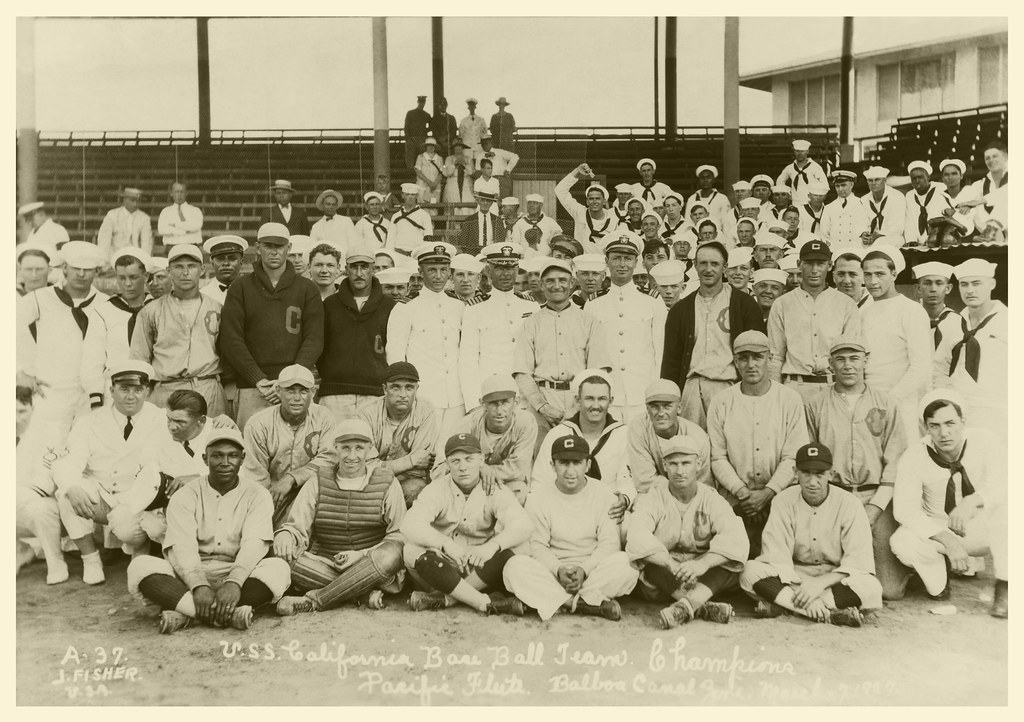
Just in time for the 2025 holiday season, we experienced a Christmas miracle of sorts. It was an online listing of a photo capturing exactly what we were hoping for: the USS California baseball team. The photo was snapped in Balboa, Panama Canal Zone after the team captured the 1927 Battle Fleet Championship. It bore the inscription on the lower front, “USS California Base Ball Team. Champions Pacific Fleet, Balboa, Canal Zone, March 7, 1927.”
What made the photo’s composition especially striking was Captain William H. Standley, standing at the center beside and pressed against his ringer, Dutch Raffeis. After we finalized arrangements with the seller, the photograph arrived and completed the incredible group of artifacts.
Related
- “Dutch” Raffeis: The Navy’s Own Flying Dutchman (StudioGaryC.com)
- Dutch Raffeis: the “Flying Dutchman” of U.S. Navy Service-Team Baseball
- James R. “Dick” Ward: ‘Colonel’ to Seaman, Diamond Star to Hero
- Sub-Hunting: Uncovering the Pearl Harbor Sub Base Nine
- Seeing Stars Through the Clouds: 1943-44 Navy Team Autographed Baseball
[1] C. F. Hughes, Admiral U.S. Navy, “U.S. Battle Fleet Athletic Rules, 1926,” USS California, Flagship, Seattle, Washington, July 30, 1926.
[2] Jim Lewis, JO2, “Sports in the Navy: 1775 to 1963,” Naval History and Heritage Command (https://www.history.navy.mil/content/history/nhhc/research/library/online-reading-room/title-list-alphabetically/s/sports-in-the-navy-1775-to-1963.html), Accessed April 29, 2026.
[3] Jim Lewis.
[4] “Admiral William H. Standley: Sixth Chief of Naval Operations,” Naval History and Heritage Command (https://www.history.navy.mil/content/history/nhhc/browse-by-topic/people/chiefs-of-naval-operations/admiral-william-h–standley.html), accessed April 29, 2026.
[5] “Navy Nines In Race For Pennant,” Press-Telegram (Long Beach, CA), May 5, 1926; p.20.
[6] “New Mexico Team Favored to Take Fleet Navy Title,” Press-Telegram, May 19, 1926; p.21.
[7] Tennessee Tar, “Fleet Sports at Panama Tabulated,” News-Pilot, March 20, 1926: p.3.
[8] Crewmembers typically served out the term of their enlistment at a single base or vessel which could be four years for a junior enlisted or newly commissioned officer, or less for more senior enlisted. Officers’ assignments were traditionally two years after they attain the rank of lieutenant. Under these personnel assignment terms, it could be challenging to build a consistent winning ballclubs, especially for smaller ships and submarines.
[9] Joe Azevedo, “Fleet Sports,” News-Pilot (San Pedro, CA), December 18, 1926: p.6.
[10] W. D. Snyder, LCDR, “Statement of Service,” United States Submarine S-49, Submarine Division Two, November 8, 1926.
[11] S. W. Canan, LT, “U.S. Naval Communication Service,” U.S. Navy Recruiting Station, Cincinnati, Ohio, November 15, 1926.
[12] “Official U.S. Naval Message: Official Business, to USS California” Bureau of Navigation, November 16, 1926.
[13] “Official U.S. Naval Message: Official Business to Navy Recruiting Station, Cincinnati, OH,” Bureau of Navigation, November 16, 1926.
[14] Enlistment contract, United States Navy, November 22, 1926.
[15] “1124 Request HYPO Raffeis” U.S. Battle Fleet Naval Message, November 24, 1926.
[16] “6326 Transfer Raffeis to USS California for duty.” U.S. Battle Fleet Naval Message, November 26, 1926.
[17] Service record entry, Henry Raffeis, December 16, 1926.
[18] Service record entry, Henry Raffeis, December 22, 1926.
[19] “Record of Raffeis – Henry,” November 1, 1918.
[20] “Record of Raffeis – Henry,” November 8, 1922.
[21] The USS California was affectionately referred to as the “Prune Barge” in both newspapers and sailor’s personal accounts. The nickname reflected the ship’s namesake and the agricultural production of sun-dried plums.
[22] Commander Joyce is referencing the February 1927 Battle Fleet visit to the U.S. Naval Mission in Brazil which was in operation for the purpose of training the Brazilian Navy and to extend American influence in South America. “Capt. Overstreet Will Speak Here on Friday Night,” The York Daily News (York, Nebraska), February 17, 1927; p. 1.
[23] Commander Charles S. Joyce, “Letter to Lieutenant Commander Rober Carney,” December 23, 1926.
[24] “Memorandum for the Executive Officer,” December 25, 1926.
[25] “Raffeis, Henry assignment to the U.S.S. California,” December 25, 1926.
[26] Service record entries, Henry Raffeis, January 11, 1927. Pp. 307, 309.
[27] “Baseball Season For Warship Players to Start Next Monday,” Press-Telegram, December 30, 1926: p. 12.
[28] “Flagship Hopes Iron Men Keep Trophy,” Press-Telegram, February 6, 1927: p. 54.
[29] “Fleet’s Baseball Games Postponed,” Press-Telegram, February 15, 1927: p. 16.
[30] “1927 United States Fleet Baseball Championship scorecard,” Chevrons and Diamonds Collection (https://chevronsanddiamonds.org/1927-united-states-fleet-baseball-championship-scouting-fleet-vs-battle-fleet-champions/), accessed May 17, 2026.
[31] “1927 United States Fleet Baseball Championship scorecard.”
[32] “U.S. Battle Fleet Athletic Rules,” July 30, 1926: p.2
[33] Charles F. Hughes, Admiral, “Raffeis, Henry, C.T.M., U.S.N., Availability of, to Participate in U.S. Fleet Baseball Series,” March 21, 1927.
[34] Charles F. Hughes, Admiral.
[35] Destroyer Wright Baseball Team Wins In Two Contests,” Honolulu Star-Bulletin, May 10, 1927: p. 8.
[36] “1927 United States Fleet Baseball Championship scorecard,” Chevrons and Diamonds Collection (https://chevronsanddiamonds.org/1927-united-states-fleet-baseball-championship-scouting-fleet-vs-battle-fleet-champions/), accessed May 17, 2026.
[37] Henry Raffies, C.T.M., “Request letter to Chief of the Bureau of Navigation,” April 22, 1927.
[38] Henry Raffies, C.T.M.
[39] “Transferred to Naval Torpedo Station, Newport, RI.,” Service record entry, May 24, 1927.
[40] M. Shawn Hennessy, ““Dutch” Raffeis: The Navy’s Own Flying Dutchman,” Infinite Baseball Card Set (https://studiogaryc.com/2023/03/10/dutch-raffeis), March 10, 2023.
[41] The photo is inscribed on the lower left front of the image.

Leave a Reply