For several years of curating baseball militaria, the category of artifacts that eluded our collection was verifiable authentic baseballs that were either made for and used by GIs or those that were autographed by the players during their tenure in the armed forces. In early 2018, we acquired our first military baseball; a 1956-dated, team-signed ball from the 36th Field Artillery Group which appeared to tear down whatever barriers that stood in our way. A few months later, we acquired a second ball.
Our second baseball find appeared in a group of items from a single collection that were all tied to military baseball teams in the Central Pacific area—particularly in and around the Hawaiian Islands during World War II. Compared with the three other auctions from that group, this piece drew far less attention. Only a few buyers were watching and ultimately bidding. The listing’s title was rather innocuous, identifying the item as an Autographed Navy team baseball from the 1940s.
In viewing the auction listing’s photos, it was clear that the ball, aside from the signatures, is easily datable as official National League (“Ford C. Frick”) Spalding piece from 1943. Aside from the obvious coating of shellac covering the ball, some of the signatures were legible though several were hard to discern. With the low minimum bid amount, we determined the minimal risk was far outweighed by the potential historical significance. With only a few hours remaining, we set our snipe bid amount and waited.

Our bid was successful and soon the ball was in hand, affording opportunity to thoroughly examine the autographs on each of the panels. Ahead of bidding, a few of the signatures were recognizable in the listing but we had yet to determine if they were from a specific team or perhaps the GI who originally owned the ball obtained autographs from players that he encountered during his time serving in the armed forces.
As we carefully compared the autographs we recognized against known wartime military team rosters, it became evident the known names were in fact members of a team we were familiar with, but we still had to narrow it down to a specific season. The autographs that stood out were from Arnold Anderson, Maurice Mozzali, Walter Masterson and Jim Gleeson which prompted a comparison to one of our Hawaiian Islands scorebooks: 4th Of July, 1943 Independence Day Baseball Program that was used for a few games hosted at Chickamauga Park at Schofield Barracks. One of the teams playing in the Independence Day festivities was the Pearl Harbor Submarine Base “Dolphins” ballclub.

Panel 1:
- Arne “Red” Anderson*
- Charlie Medlar
- Maurice Mozzali*
- John Powell*
- Tom Bishop**
- Bob McCorkle*
- Walter Masterson*
- Bill Gerald
Starting with the first panel, the known autographs were from pitcher Arne Anderson who was signalman, chief athletic specialist and pitcher Walt Masterson both played in the major leagues. Catcher and Coxswain Bob McCorkle and Torpedoman 1/c and pitcher Maurice “Mo” Mozzali had minor league careers with the latter serving as a scout in the St. Louis Cardinals organization for 18 years followed by two seasons (1977-78) as a coach with the big-league club. Pitcher Charlie Medlar was a minor league pitcher in the Detroit organization from 1941 to 1942.
John Powell, listed on the “Navy” roster for the April 19, 1944, scorecard for the game between the Navy and the Major League All-Stars as a center fielder and an MS 1/c, Electrician’s Mate 2/c and shortstop Tom Bishop, and middle infielder Bill Gerald were all sailors with pre-war amateur or semi-pro experience.

Panel 2
- Raymond Keim
- Dutch Raffeis
- Karl Gresowski
- Jim Brennan
- Bob Tomkins
- Ed Quinn
This panel initially posed a significant challenge, While three of the autographs were easy to discern, the fading of the others significantly impacted our ability to read them. Through comparisons against our printed sources and our assembled roster, all six emerged from obscurity. Pitcher Jim Brennan is found on our April 19, 1944, program but is listed as “J. D. Brennen,” and was rated as an EM2/c.
“Dutch” Raffeis’ autograph stood out on this panel and similarly, through our individual research emerged as a substantial figure in Navy baseball dating back to 1915. Raymond Keim, Karl Gresowski, Bob Tomkins, and Ed Quinn were all regular sailors without organized baseball experience.

Panel 3
- Gene Atkinson
- Gene Rengel
- Bob White
- Floyd Snider
- Phil Simione
- Emil Patrick
- Ray Volpi
Of the seven signatures on the third panel, three have professional pre-war experience. Pitcher Bob “Clovis” White, EM2/c, had five years of experience in the minor leagues spending 1938-39 in the Boston Red Sox organization. Pitcher Ray Volpi, not to be confused with current Yankees shortstop Anthony Volpe, spent 1938-42 in the Yankees organization reaching Kansas City in the American Association in his final season. Volpi spent the first part of 1943 pitching for the Norfolk Naval Training Station “Bluejackets” before being transferred to Hawaii. Right fielder Floyd Sninder spent his first professional season in the Georgia-Florida League with Dothan in the St. Louis Browns organization. After the war, he played in parts of six seasons from 1946 to 1952.
Emil Patrick was a sailor serving the silent service before finding a late-season roster spot on the Dolphins. After the war, Patrick pitched in the Yankees organization from 1949 to 1953. He reached his peak of professional progression from 1954 to 1955 with the Sacramento Solons in the Pacific Coast League. In his last professional season, Emil Patrick pitched for the class “AA” Auston Senators in the Texas League in 1957. Gene Atkinson, Gene Rengel, Floyd Snider and Phil Simione were all fleet sailors prior to landing on the team.

Panel 4
- Jim Gleeson
- John Jeandron*
- F. T. Hecklinger*
- Oscar “Chicken Hawk” Sessions*
The final group of autographs are found predominantly on the ball’s sweet spot and are fortunately quite legible. One of the three signers with professional pre-war experience is outfielder Jim Gleeson who played in the big leagues from 1936 to 1942 with the Indians, Cubs and Reds before entering the U.S. Navy. After the war, his big-league years were in the past, playing at the highest minor league level from 1946 to 1951. First basemen John Jeandron, Pharmacists’ Mate 3/c and Gunner’s Mate 3/c Frank Hecklinger served in class “D” ball before the war and resumed their minor league careers after separating from the Navy.
Standing out among this panel is the signature “Chicken Hawk” Sessions. Chief Electrician’s Mate Oscar Sessions was a career sailor who enlisted in 1936. By 1942, he was serving aboard the heavy cruiser USS Minneapolis (CA-36) and had participated in the Coral Sea and Midway Battles. In November, the cruiser sustained crippling damage during the Battle of Tassafaronga losing her entire bow just ahead of the turret and magazine of the forward eight-inch main battery from a Japanese torpedo. While 37 men were killed in the battle and another 36 were wounded, the crew saved the ship from sinking, enabling her to limp to Tulagi. Aided by Sea Bees on the island, a temporary bow was fashioned to allow the ship to steam independently to Pearl Harbor for repairs that would enable the ship to reach Mare Island. While at Pearl, Oscar Sessions was discovered as a viable hurler, and arrangements were made to transfer him to the Sub Base where became a star pitcher for the Dolphins. He helped pitch the team to the triple crown of navy and civilian league baseball championships and pitched in the 1944 Servicemen’s World Series.

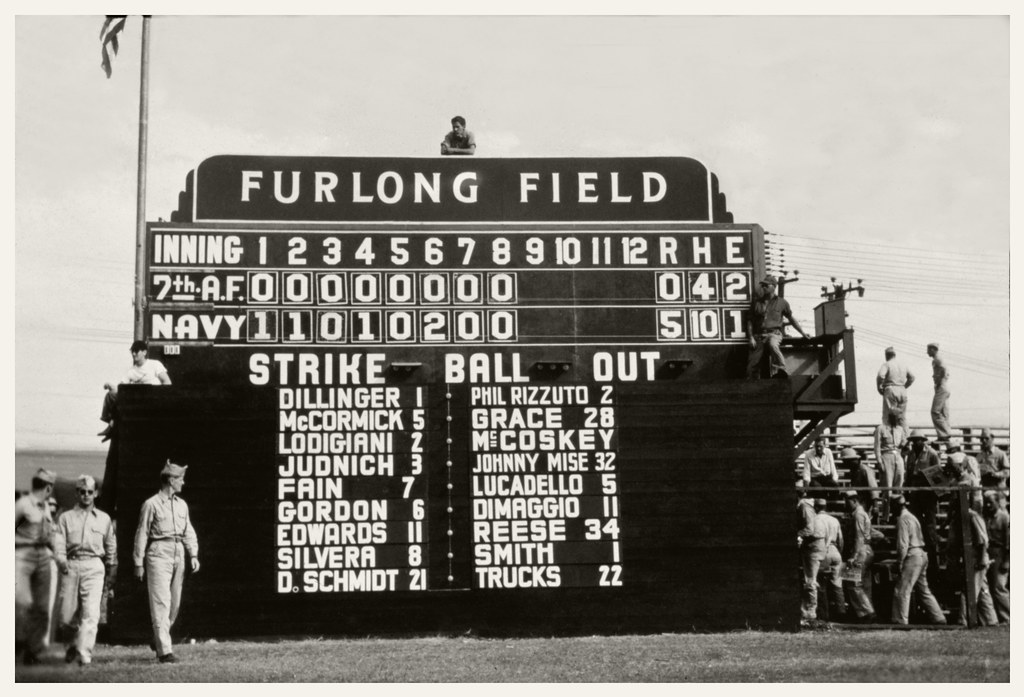
This artifact is a significant piece of Navy and Hawaii baseball history due to the team’s significance. Ultimately, the Dolphins’ was an embarrassment to their Army competition which led to the establishment of the 7th Army Air Force team’s dominance in 1944 with the additions of three future Hall of Fame players from the New York Yankees: Joe DiMaggio, Joe Gordon and Red Ruffing along with a host of major league all-stars and minor leaguers who became big league stars after the war.

Leave a Reply