A note to our readers: This is the third of a four-part story. We will include links to each segment for easy navigation.
Part 1: The Bomber Brownie: Walt Judnich
Part 2: 7th Army Air Force Bombing Command
1944 Servicemen’s World Series
As the Fliers dispatched the Navy to claim their Cartwright Series title, Judnich’s former team, the St. Louis Browns, after defeating the Senators on September 21, trailed the Detroit Tigers by a half game in the American League pennant chase in a season that saw rosters absent their stars due to wartime service. The Browns, despite suffering a similar fate, retained much of their pre-war roster with many players rejected for military service. Manager Luke Sewell led his club to a strong finish. The Browns won 11 of their final 12 games in a neck-and-neck race to take the pennant with a single game margin over the Tigers. Making it to the Fall Classic had been achieved for the first (and only) time in the club’s history and Walt Judnich was so far away that he might as well have been on a different planet.
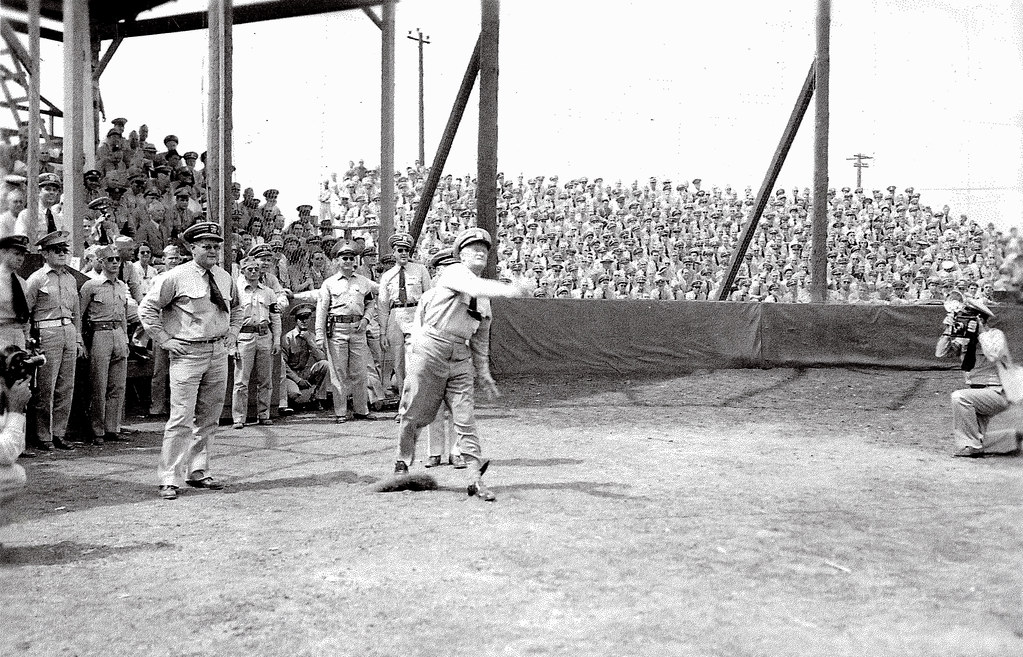
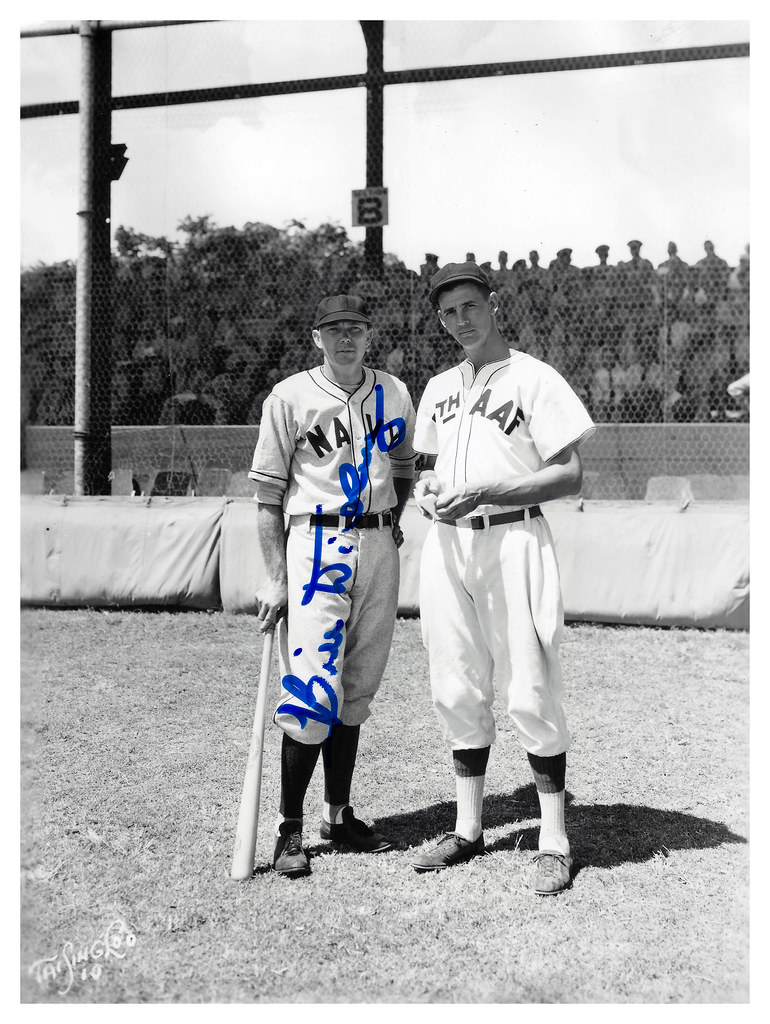
Judnich may have been half an ocean away, but he was not on a different planet, and he was about to play in a World Series that featured some of the biggest names in the game. The team rosters in Servicemen’s World Series, also known as the Army-Navy All-Stars, featured players with big-league post-season experience. The Navy squad, led by former Yankees legend Bill Dickey, included Hugh Casey, Johnny Mize, Pee Wee Reese, Phil Rizzuto, Schoolboy Rowe, and Johnny Vander Meer. The Army’s roster included the 1942 World Series pitching hero for the Cardinals, Johnny Beazley, plus Joe Gordon and Mike McCormick. Though he was listed as a member of the Army stars, Joe DiMaggio was sent stateside ahead of the series, battling his season-long, disabling ulcers.
Joe’s younger brother, Dom DiMaggio, an All-Star for the Red Sox in two of his first three big league seasons, was flown in from Brisbane, Australia along with Joe’s former Yankee teammate Rizzuto to augment the Navy’s roster.
Servicemen’s World Series dates, locations, and attendance:
| Game | Date | Location | Attendance |
| Game 1 | September 22, 1944 | Furlong Field, Pearl Harbor | 20,000 |
| Game 2 | September 23, 1944 | Flood Field, Hickam AAF | 12,000 |
| Game 3 | September 25, 1944 | Redlander Field, Schofield Barracks | 14,500 |
| Game 4 | September 27, 1944 | NAS Kaneohe Bay | 10,000 |
| Game 5 | September 28, 1944 | Furlong Field, Pearl Harbor | 16,000 |
| Game 6 | September 30, 1944 | Flood Field, Hickam AAF | 12,000 |
| Game 7 | October 1, 1944 | Furlong Field, Pearl Harbor | 16,000 |
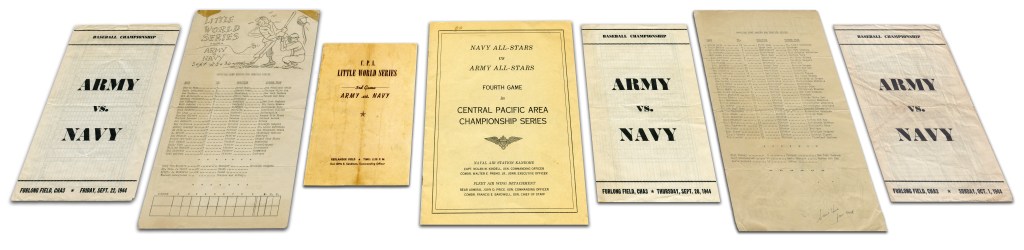
On paper, the two rosters set the stage for the Servicemen’s World Series to be one of the most competitive post-season contests in baseball history, if not the most memorable for those in attendance. Regardless of what was taking place with his former team in St. Louis, Judnich, one of the slugging stars of the 1944 Hawaii baseball season, was on the eve of playing in a post-season series that would have been one for the major league record books if played in Yankee Stadium or Ebbets Field.
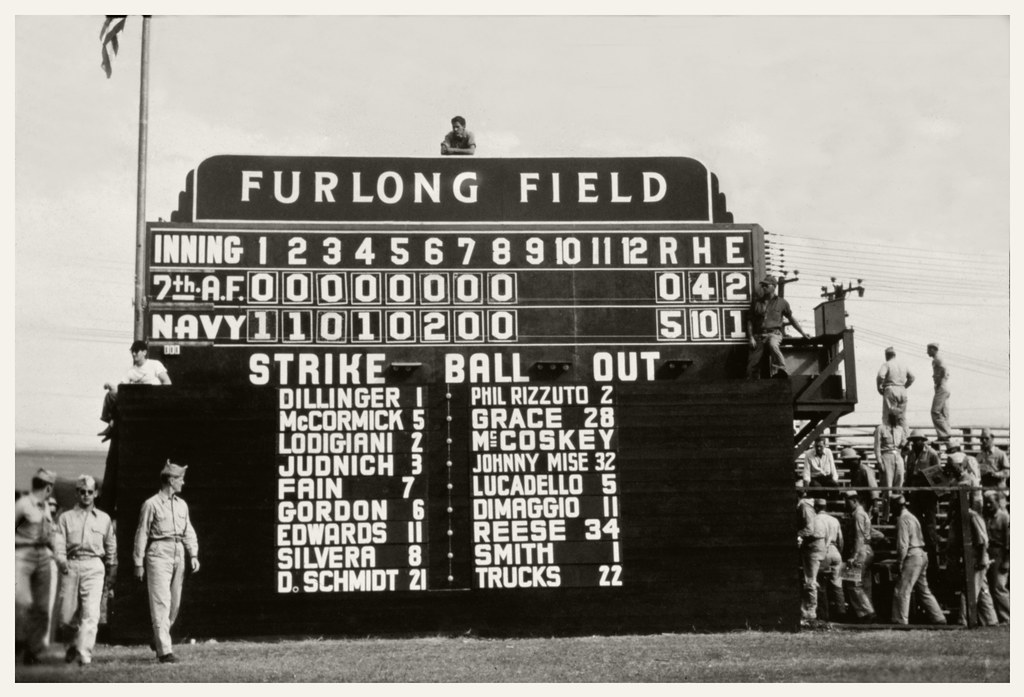
While the Series was a resounding success for the Navy and the 100,500 GIs who witnessed incredible baseball, for Judnich and his Army teammates, it was a disaster.
The 7th’s Hawaii and CPA Leagues domination should have left few doubts that the Army All-Stars, whose core was comprised largely of Fliers further augmented with other Army players, would be the heavy favorites in the Series as big hitters Judnich and Mike McCormick tilted the scales heavily in their favor.[1] However, with Walt’s power-hitting prowess, columnist Red McQueen predicted Navy manager Dickey would call virtually every pitch to Judnich to be high and outside,” effectively neutralizing the former Brownie’s bat.[2] McQueen, citing the Navy’s overwhelming star-power combined with Bill Dickey’s game-calling, predicted the Navy would take the series in six or fewer games.[3]
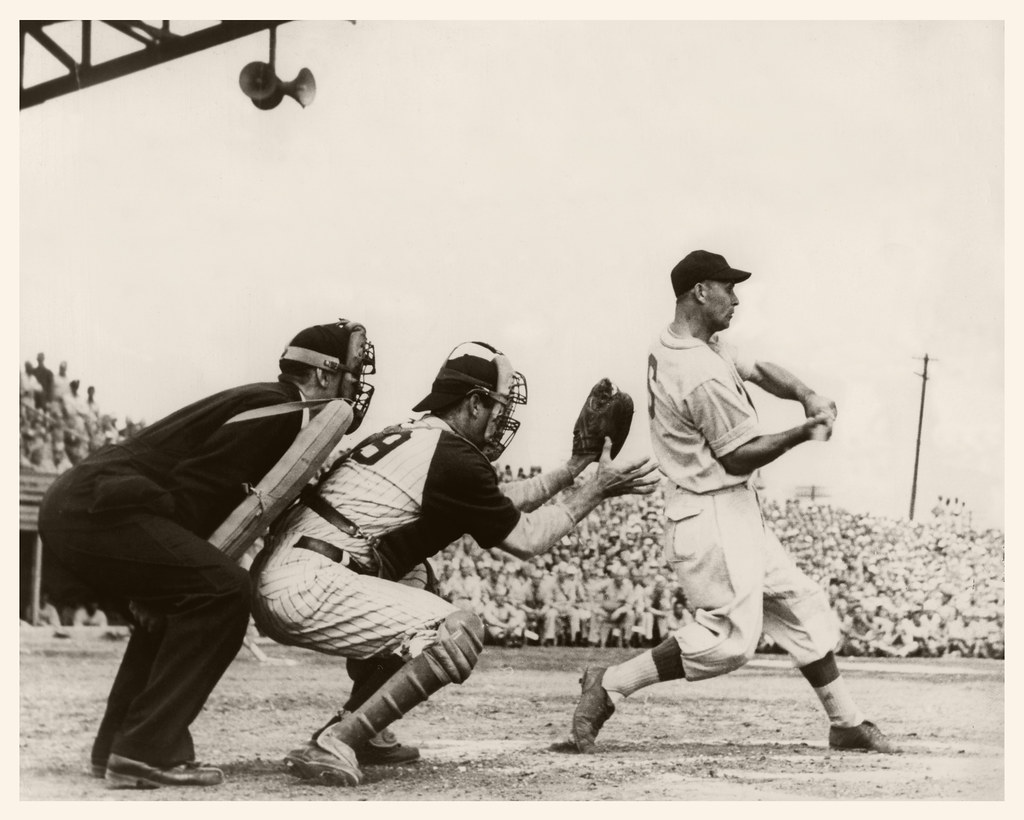
After being embarrassed by the Navy with a Virgil Trucks 5-0 shutout in opening game and an 8-2 rout pitched by Johnny Vander Meer and Hugh Casey in the second tilt, Army rebounded as their offense awakened in the third. McQueen’s prediction held true as Judnich was hitless in games 1-2 in eight trips to the plate. Tom Ferrick, on the mound for Navy in Game 3, was staked to a 2-0 lead in the first inning. Judnich launched a Ferrick fastball 375 feet deep in the second frame to cut the lead in half. In the third inning, Walt singled in a run and scored on a McCormick single. Navy knotted the game at three runs in the top of the fourth, and the game remained tied until the 12th when Navy’s Ken Sears drove a solo shot over the right field fence to put the gobs back on top. Hugh Casey kept Army bats silenced in the bottom of the frame to seal the 4-3 victory.
Playing on Navy home turf at Naval Air Station Kaneohe Bay before a standing-room-only crowd of more than 10,000 sailors, marines and soldiers, Navy jumped out to an 8-0 lead in Game Four, tallying runs in each of the first five frames while Virgil Trucks held Army batters hitless. In the top of the sixth, Army batters broke out. Judnich singled to right to get the party started. Fain followed with a two-run blast. Gordon tacked on another run with a solo shot on the first pitch he saw. Trucks walked Lodigiani and Bob Dillinger pushed him across the dish with a long single. McCormick drew a walk, prompting Dickey to lift Trucks in favor of Schoolboy Rowe. Hank Edwards drove Dillinger in with a long single of his own, capping the scoring at five before Schoolboy got the final out of the frame. Army trailed Navy, 8-5. Rowe finished the balance of the game without allowing further Army tallies. Navy tacked on a run in the bottom of the sixth inning and also the seventh inning to nail down the 10-5 victory and complete the four-game series sweep.[4] Red McQueen’s prediction was spot-on; the Navy captured the crown in “less than six” games.
- Game 1 – Navy defeated Army, 5-0
- Game 2 – Navy defeated Army, 8-2
- Game 3 – Navy defeated Army, 4-3
- Game 4 – Navy defeated Army, 10-5
Judnich was stymied at the plate in the first two games, but he found his groove in Games Three and Four with a pair of hits in each including a home run. Perhaps Trucks, Vander Meer and Casey followed through on McQueen’s prediction of pitching away from Walt in those two contests. Either he started to get better opportunities in the third and fourth tilts, or he started to see the ball better. Regardless, Judnich, along with the entire Army roster, was offensively inept. Judnich hit just .235 in the Navy’s four-game sweep.
Judnich’s performance, games 1-4:
| Game | AB | R | H | 2B | 3B | HR | PO | A | E |
|---|---|---|---|---|---|---|---|---|---|
| One | 4 | 0 | 0 | 0 | 0 | 0 | 2 | 2 | 0 |
| Two | 4 | 0 | 0 | 0 | 0 | 0 | 3 | 0 | 0 |
| Three | 5 | 1 | 2 | 0 | 0 | 1 | 5 | 0 | 0 |
| Four | 4 | 1 | 2 | 0 | 0 | 0 | 2 | 0 | 0 |
Through the four games of the Servicemen’s World Series, more than 56,000 GIs witnessed major-league caliber competition demonstrated by some of baseball’s biggest big-league stars. To ensure as many service members as possible could enjoy the series, the decision was made to play all seven games.[5]
After losing Game Five at Furlong Field and Game Six at their home, Hickam’s Flood Field, the Army stars finally accomplished a victory over Navy in the closing game of the Series back at Furlong.
The main sports page headline on the October 2 edition of the Honolulu Advertiser announced the historic victory of Judnich’s Browns taking down the mighty Bronx Bombers to secure the club’s first, and what would prove to be their only, American League pennant. As fate would have it, a 34-year-old rookie pitcher and Army veteran hurled the Browns to a 5-2 victory over the Yankees, locking in the Browns’ one-game lead over Detroit in the final American League standings.[6] In another piece of baseball irony, Jakucki served at Schofield Barracks and played ball for the main post ball team. In an adjacent story with a smaller typeface, the headline telling of the Army All-Stars’ victory over the Navy in the final Servicemen’s World Series game, while a long time coming, paled in comparison.[7]
The fifth game was another Navy blowout victory despite Judnich’s double, walk and scoring one of the Army’s two runs. In Game Six, he cracked a single and worked a walk, but it was for naught as Army fell for their sixth consecutive loss. In the seventh and final tilt, Army finally overcame the Navy as Judnich managed another hit and free pass.
Judnich’s performance, Games 5-7:
| Game | AB | R | H | 2B | 3B | HR | BB | SO | PO | A | E |
|---|---|---|---|---|---|---|---|---|---|---|---|
| Game 5 | 4 | 1 | 1 | 1 | 0 | 0 | 1 | 1 | 1 | 0 | 0 |
| Game 6 | 4 | 0 | 1 | 0 | 0 | 0 | 1 | 0 | 0 | 1 | 0 |
| Game 7 | 3 | 0 | 1 | 0 | 0 | 0 | 1 | 0 | 2 | 0 | 0 |
Judnich batted .273 over the final three games to elevate his Servicemen’s World Series batting average to .250, trailing Ferris Fain’s .269, the Army’s leading average in the series.[8]
- Game 5, Navy defeated Army, 12-2
- Game 6, Navy defeated Army, 6-4
- Game 7, Army defeated Navy, 5-3
Navy’s athletic officer, Commander Tom Eddy, announced ahead of Game Three that both teams and the umpires were set to travel to Maui and Hilo after the conclusion of the Series. Four games were scheduled, with two set for Maui on October 3-4 and on the big island, Hawaii, for October 6-7.[9] However, after four games were in the books and the two-island, post-series tour shaping up, officials on Kauai were seeking to be included and requested a pair of games to be played for the benefit of the GIs serving on their island.[10]
Post-Series Island tour dates, locations, and attendance:
| Game* | Date | Location | Attend |
| Game 8 | October 4, 1944 | Maui Fairgrounds | 10,000 |
| Game 9 | October 5, 1944 | Maui Fairgrounds | 10,000 |
| Game 10 | October 6, 1944 | Hoolulu Park, Hilo, Hawaii | 8,000 |
| Game 11 | October 15, 1944 | Kukuiolono Park, Kauai | 20,000 |
The two Servicemen’s World Series rosters were relatively unchanged, though these games were not officially considered to be part of the Series but rather exhibitions for the benefit of troops stationed on these islands.

The seven-game series in the books, Phil Rizzuto and Dom DiMaggio were returned to Australia as the two clubs were heading to Maui for a pair of games. Pee Wee Reese remained on Oahu, battling appendicitis, [11] leaving the Navy roster down three of its biggest contributors in the Servicemen’s World Series.
Navy’s Jack Hallett pitched the gobs to a three-hit, 11-0 shutout of Army in the first of the two Maui games at Kahului Fairgrounds on October 4, prompting Army manager Winsett to bench the struggling Bob Dillinger and Judnich for the second game. In that contest, Army bats responded after falling behind 4-0 in the second inning, cutting the lead in half in the bottom of the fourth. Three more runs in the eighth before Navy plated a run in top of the ninth to knot the game at 5-5. With Joe Gordon on second base in the bottom of the ninth, Navy second baseman Al Brancato threw wide of first, allowing Gordon to score the 6-5 game winner on the error, thus splitting the Maui series.[12]
The All-Stars traveled to the big island for a single game at Hilo’s Hoolulu Park. The contest was called after 14 innings as darkness settled in on the 6-6 tie. For Walt Judnich, the day out of the lineup did little to spark his offense as he was limited to a hit and a walk in six trips to the plate. Dario Lodigiani accounted for two of Army’s runs on his three-for-five performance.[13]
Ten days later, on October 15, the All-Stars visited Kauai for their last game. Playing at Kukuiolono Park, the Army jumped out to a two-run lead, holding their advantage until Navy pulled ahead, 5-3, in the sixth. Army evened the score at five runs apiece in the bottom of the ninth, sending the game into extra innings. Navy pulled ahead, 6-5, in the top of the tenth, and Hugh Casey closed the door on the game.[14]
During the remainder of autumn and into the winter months of 1944, former major and minor leaguers continued to arrive on Oahu. Judnich spent that time working at an Army rest and recuperation camp that supported combat-worn veterans who spent a few weeks away from the front lines. Sgt. Judnich supervised GI athletics with a focus on basketball.[15]
The 7th AAF’s manager, Lieutenant Tom Winsett, was promoted to officer-in-charge of the Army Air Forces Pacific Ocean Area Baseball, overseeing three “new” teams: the Hickam Field Bombers, Wheeler Field Wingmen and Bellows Field Fliers. Since the end of the 1944 season, Army Air Forces players had continued to arrive from the mainland. These men, along with the players who remained at Hickam from the 1944 7thAAF Fliers roster, were distributed across the three new teams located at Wheeler Field, Hickam Field, and Bellows Field. Sergeant Judnich, along with his 7th AAF teammates Bob Dillinger, Al Lien, Bill Leonard, and Bill Schmidt, were assigned to the Bellows nine with the Honolulu League season set to commence on January 28, 1945. [16]
Continue to part 4: Bellows, the 313th Bomb Wing and Home
[1] Eli Lazarus, “Scribe Compares Service Outfielders,” Honolulu Star-Bulletin, September 21, 1944: p.12
[2] Red McQueen, “Hoomalimali: The Navy In Six Or Less,“ Honolulu Advertiser, September 22, 1944: p.12.
[3] Red McQueen.
[4] Bill Kim, “Navy Wins Service World Series,” Honolulu Advertiser, September 28, 1944: p.8.
[5] Red McQueen, “Hoomalimali: Additional Notes On The Service World Series,” Honolulu Advertiser, September 28, 1944: p.8.
[6][6] Leo Patterson, “Sig Jakucki Hurls Browns To AL Flag,” Honolulu Advertiser, October 2, 1944: p.10.
[7] Ensign Charles Fowler, “Homers Give Army 5-3 Win Over Navy, “Honolulu Advertiser, October 2, 1944: p.10.
[8] “Mize Leads Batters in Service World Series,” ,” Honolulu Star-Bulletin, October 2, 1944: p.11.
[9] Red McQueen, “Hoomalimali: Additional Notes On The Service World Series,” Honolulu Advertiser, September 26, 1944: p.8.
[10] Red McQueen
[11] Bert Nakah, “Sport Dirt,” Hawaii Tribune-Herald (Hilo), October 8, 1944: p.6.
[12] “Army Cops Second Game In GI Series,” Hawaii Tribune-Herald, “October 5, 1944: p.1.
[13] Bernie Friewall, “Army, Navy Battle to 14-Inning 6-6 Tie; Five Homers,” Hawaii Tribune-Herald, “October 7, 1944: p.7.
[14] M. Shawn Hennessy, “Game 11 – Baseball Championship Series – Sunday, October 15, 1944,” Chevrons and Diamonds (https://chevronsanddiamonds.org/game-11-baseball-championship-series-sunday-october-15-1944), accessed February 27, 2026.
[15] Doyle Seeley, “Bellows Ball Stars Kept Busy Off-Season,” Honolulu Advertiser, January 24, 1945: p.6.
[16] Loui Leong Hop, “Baseball Stars Assigned to AAF Teams Here,” Honolulu Star-Bulletin, December 27, 1944: p.10.
 Chevrons and Diamonds
Leave a comment