Baseball memorabilia is a highly specialized sub-category of militaria collecting that poses many challenges ranging from availability of artifacts to resources that can be used to facilitate authentication. The two most challenging types of baseball militaria that pose considerable struggles for sourcing are with baseballs and bats. Though a handful of game-used military bats have surfaced over the years, we have only been successful in securing a small number of them for my collection.
In a few collectors circles, discussions surrounding methods for determining factors and features for what constitutes military or service team equipment. Unlike issued military gear (uniforms, weapons, tools and equipment) that has procurement markings that are applied either via labeling, stenciling or engraving, sports equipment can be and often is unmarked. Considering that during World War II sports equipment wasn’t procured through government contracts or appropriations, a large and unknown percentage of the gear was distributed and disseminated to the troops without being marked. It is highly likely that gloves, balls, catchers’ protective equipment and bats were commonly lacking indicative military (U.S. Army, U.S. Navy, U.S.M.C, etc.) or government marks (U.S.). As this was the case, aside from provenance directly connected to a piece, all of this equipment is relegated to simply being specific-period sports equipment.
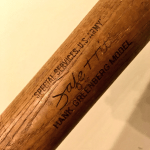
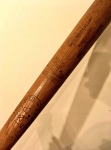


Much of the equipment sent to the troops did receive markings that are can be a bit of a challenge to understand (especially in the area of gloves). Regarding baseball bats, inconsistencies abound in terms of both applied military or government-esque markings and with the varying brands and models that were distributed. Although bats made by Hillerich & Bradsby dominated the market during the 1940s, their brand wasn’t the only one finding its way to the combat-theater diamonds and domestic-base fields as examples of other makers could be seen in the hands of ball-playing GIs from makers such as A. J. Reach, Wilson, Goldsmith and Spalding. Other considerations must also be made for brand subsets as Hillerich & Bradsby catered to different markets such as professionals, collegiate, little leagues and amateurs for their products. Aside from the well-known Louisville Slugger models (which had both professional and consumer variants), Hillerich & Bradsby also manufactured the H&B branded bats which were a lower grade and inexpensive offering (see: Louisville Slugger Bat Dating Guide at KeyManCollectibles.com). Considering that equipment originated from various sources (purchased on behalf of the troops through the Professional Baseball Fund, the Bat and Ball Fund, the USO, etc., donated by minor league teams or even produced and donated by the equipment manufacturers themselves), collecting and verifying military-use (without the aforementioned military markings) can pose an authentication challenge for collectors.


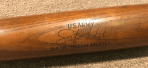
For our collection, military-used bats have been difficult to acquire due to the limited numbers that have come to market since we have been on the hunt. The first piece that we were able to acquire wasn’t a baseball bat but rather a WWII H&B model 102 Soft-Ball bat with a U.S.N. stamp (1940s softball bats had significantly smaller barrel diameters than their baseball counterparts) with a taped handle. The condition, though used is excellent showing no signs of rot or grain separation. After a minor cleaning and coating the bat with linseed oil, the bat looks fantastic. It took several years before we were able to land our second bat, this time an actual baseball model, which turned out to be a rather rare Ted Williams signature H&B version (see: Ted Williams: BATtered, Abused and Loved) which is a welcome addition to the collection, especially after giving it a slight restoration.
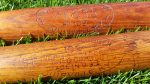

Recently, another bat that came by way of a fellow baseball and (new) militaria collector is a Louisville Slugger Model 102 Soft Ball bat with a simple U.S. stamp. This particular bat arrived with a fairly heavy-handed in-process restoration (the finish was removed and the wood had been sanded smooth). Thankfully, the stamped brands were still very apparent (if not slightly softened from the finish removal and resurfacing) prompting me to apply a few liberal coats of linseed oil. With the new finish applied, the grain of the wood was intensified and the appearance was greatly enhanced. Within the span of a few months, my military baseball bats collection tripled though two of the three were softball pieces.

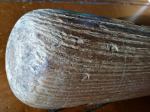
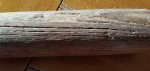
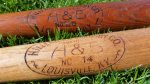
In the last few weeks, yet another piece surfaced that looked to be a fantastic fit in several aspects: condition, player endorsement, military markings and bat model. Similar to the Ted Williams bat already in our collection, this piece also carried the H&B brand but with a Model 14 designation. The best part of all was that the price was right. Aside from the lengthy shipping time, we were elated when the package arrived intact. When we removed the stick from the box, we discovered that the condition was in a bit worse state than had appeared in the seller’s photos. On the face of the barrel (opposite the brand and markings), there is some grain separation with a layer of the wood pulling away leaving a very apparent crevice. Also not visible in the photos is a missing wedge section from the knob which, for a 75 year-old and well-used bat is fairly minor. The brand and the stampings are somewhat shallow and appear to be either worn or perhaps sanded during an older restoration attempt. Despite these minor aesthetics issues, the bat will clean-up nicely and look exceptional with a liberal coating of linseed oil.


Having mentioned in a smattering of articles over the years that this author’s teams are the Dodgers and Red Sox, it should make sense that the endorsement on this new acquisition (as with the Ted Williams bat) features a prominent Boston slugger who was nearing the end of his storied career during World War II. By the start of the 1942 season, 34 year-old Jimmie “Double X” Foxx was suffering from a broken rib that he sustained during spring training which nagged him throughout the season. By June 1, “The Beast” (as he was also known) sold to the Chicago Cubs by the Red Sox much to the disappointment of the Boston faithful. Foxx appeared in 70 games for the Cubs but his production was greatly diminished (as compared to his career) prompting him to announce his retirement at season’s end. In 1943, Foxx spent the year away from the game, spending time with his new wife and her two children before volunteering for military service only to be rejected due to a medical condition. Instead of Jimmie Foxx finding his way into an armed forces uniform and serving overseas, his name traveled the globe to far away diamonds on signature gloves and endorsed bats such as this one.
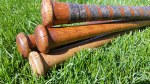

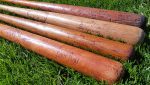
With the Red Sox represented in our collection with two endorsed models from these legendary (and Hall of Fame) hitters, the hunt is on for a WWII service team Dodgers bat.


 Chevrons and Diamonds
Leave a reply to panzerheld Cancel reply