Baseball took center stage for GIs following the unconditional surrender of the Third Reich in the spring of 1945. Units across the European Theater and Mediterranean fielded baseball teams competing in regional leagues commencing in early June. By the end of July, the cream had risen to the top as league champions began facing each other culminating in the champions of the various armies. By September, the 71st Division “Red Circlers,” the Third Army champs faced the Oise “All-Stars” in the first GI World Series in the European Theater and lost in the best-of-five series with future Cooperstown enhrinees, former Negro Leaguers Willard Brown and Leon Day leading the charge.
The tradition carried forward throughout the post-war years as major leaguers wound down their service careers and service team rosters were filled with athletic soldiers and some former professionals who were still serving. In the void of Hitler’s reign, the iron fist of Communism took a foothold in Eastern Europe and within the now divided Germany with the Soviets control over half of the former nation and its capital, Berlin. While baseball continued to be an outlet for American troops stationed within the region, the threat of the Communist’s stranglehold loomed large. For nearly a year between Jun 24, 1948, and May 12, 1949, West Berlin, land-locked within East Germany, required regular flights of supplies via the “Berlin Airlift” as the Soviets attempted to choke off supply lines the city by restricting all vehicle access. Baseball soldiered-on and the European Command (EUCOM) and Northern Conference champion Heidelberg Hawks faced the Southern Conference champion Wurzburg Warriors in the 1949 GI World Series, hosted at Mannheim Stadium.
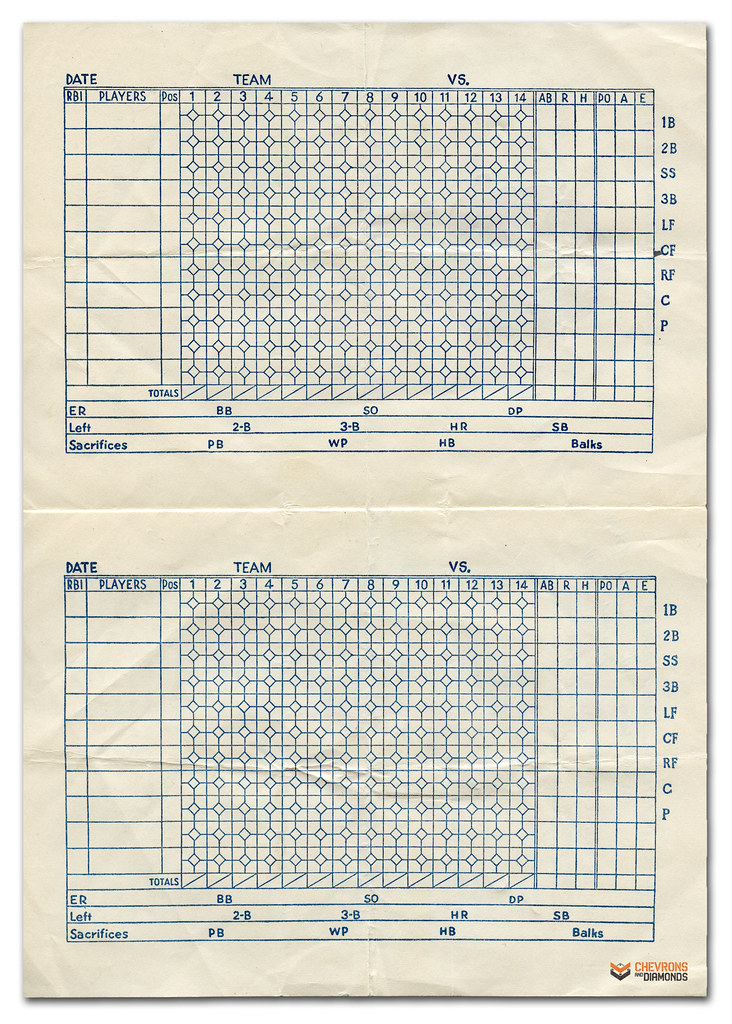
Download to view the entire 1950 GI World Series Game One Scorecard
The 1950 season saw the Heidelberg squad repeat as the EUCOM and Northern Conference championships to find their way back to the GI World Series led by starting pitchers Bishop Taylor (7-0), Everett Linker (7-4), and former Birmingham Black Barons hurler, Sam Burris (4-1). Hawks battsmen, “Snuffy” Grimm, Charlie McGuire and Geronimo McConnell, led the team with averages exceeding an astonishing .350 mark.
The Southern Conference champion Munich Broncos were dominating during regular season play, posting an overall 61-66 won-loss record with two of their losses in non-league exhibition games. Pitchers Bob King (10-0), Bob Pearson (8-0), and Sgt. Johnny Murphy (6-0), overpowered opponents throughout 1950. Catcher Irv Lyles and outfielder Bob Crowe each clobbered opposing pitching to the tune of .425 averages. Infielders Matt Mack, first baseman (.411) and Robert “Abduhl” Johnson (.350) held their own.
On July 26, 1948, President Harry Truman signed Executive Order 9981 directing the armed forces to integrate the Army, Navy, Air Force and Marines and by 1950, the Navy Department, which included the Marine Corps, and the Air Force successfully carried out the directive for complete equality of treatment and opportunity for all troops. After more than two years, the Army had failed to comply with the President’s order. Still functionally segregated, the Army sent the 24th Infantry Regiment, a Black unit, to the Korean Peninsula in 1950 as part of the first offensive of that war.[1]
In 1950, more than 92,000 Americans were serving in the U.S. Army in Germany of which more than 8.000 were Black. However, the rosters of the Heidelberg Hawks and Munich Monarchs were significantly integrated with each featuring 12 Black players including two former Negro Leaguers.[2]
The Munich Broncos’ win over the 18th Infantry “Vans” in the Southern Conference Championship series gave them the title and sent them Mannheim, Germany to the GI World Series to face the veteran Heidelberg club.
1950 Heidelberg Hawks:
| # | Player | Position | Former |
|---|---|---|---|
| 12 | Bob Alderman | P | |
| 9 | Bill Armstead | RF | |
| 1 | Claude Barker | C | |
| 2 | Shaw Brannon | C | Fort Smith (WA) |
| Felton Brown | Coach | ||
| 4 | Tom Buckner | 2B | |
| 10 | Sam Burris | P | Birmingham Black Barons |
| 16 | Ed Czerminski | P | |
| 19 | Dick Gardner | SS | |
| 6 | Snuffy Grimm | 3B | |
| 15 | Steve Gutman | 1B | |
| 5 | Charlie Howard | 3B | |
| Ray Jackson | Mgr. | ||
| J. R. Jones | 1B | ||
| 14 | Everett Linker | P | |
| 18 | Stewart Mallison | P | |
| Geronimo McConnell | CF | ||
| 7 | Charlie McGuire | LF | |
| 20 | Roley Sparks | 2B | |
| 3 | Bishop Taylor | P | |
| 17 | Denzel Truss | OF | |
| 13 | Bob Walton | Coach | |
| 11 | Zeke Zebzda | RF |
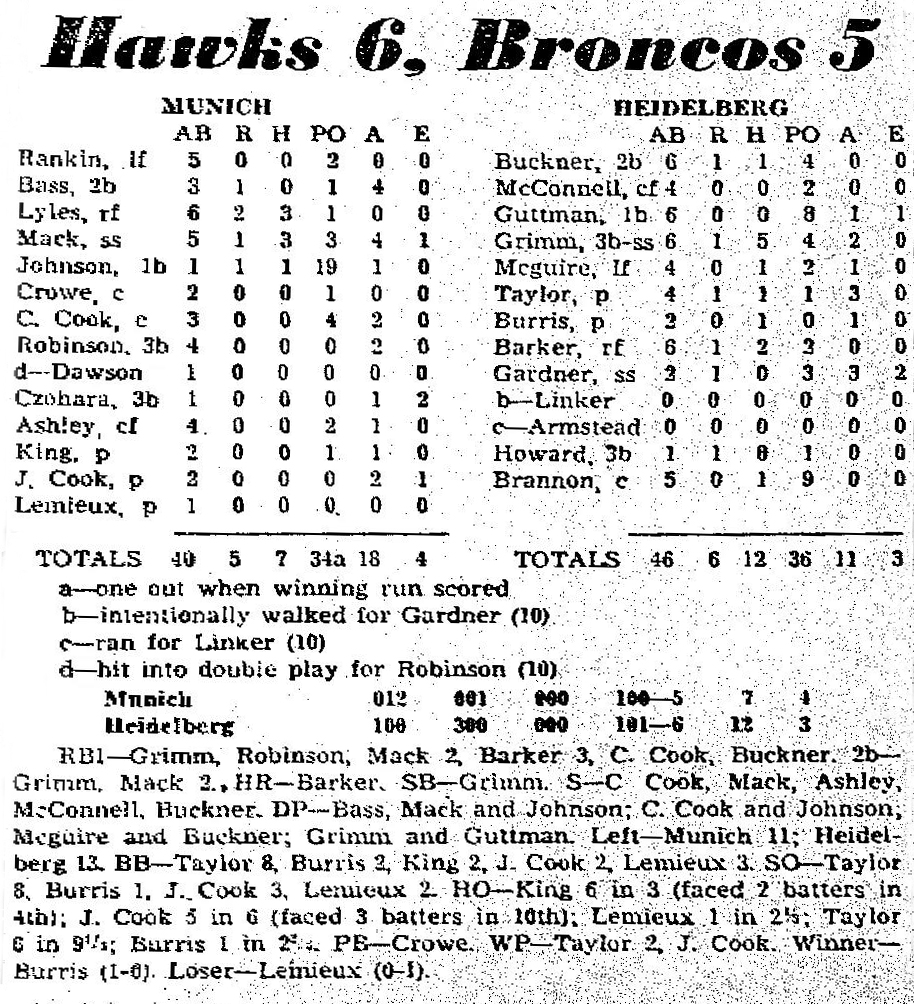
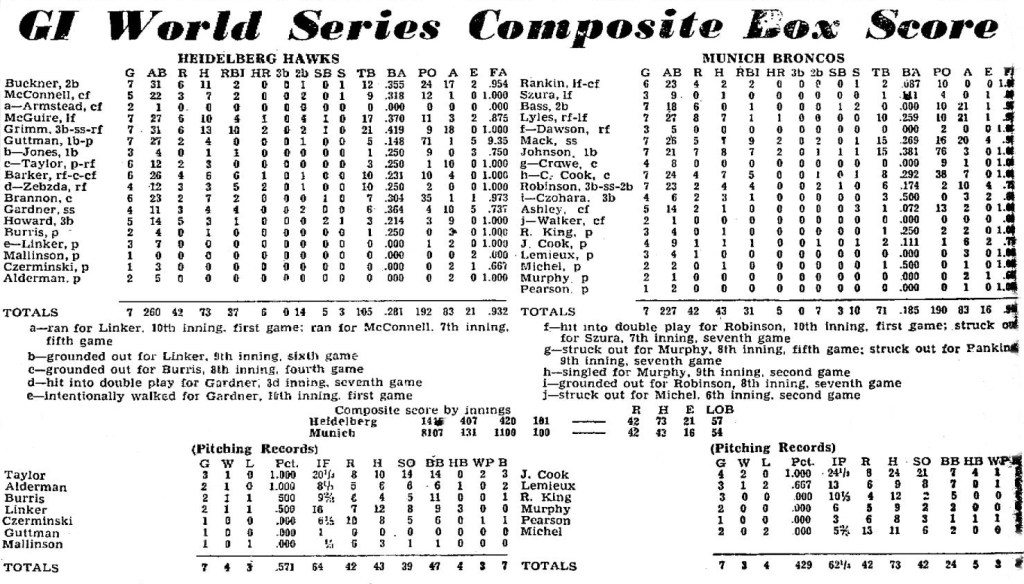
The series was an intense battle. Heidelberg jumped out to a commanding two-game lead winning Game One on a suicide squeeze play in the bottom of the 12th inning. Reeling from the late-inning loss, Munich was flat as the Hawks crushed Broncos pitchers for 11 runs in the second game while holding their opponent to a pair of tallies. Game Three saw the venue shift from Mannheim Stadium to the Broncos’ home field. The Broncos feasted on home-cooking and Heidelberg pitching for a crushing 16-2 victory in the third tilt.
The Series was all tied after a four-hit, 6-0 shutout Game Four victory as Broncos batters were outscoring the Hawks 29-19 heading into the fifth game. It was another bashfest for Heidelberg who tagged Munich pitching for 16-runs while holding them to a pair. The Broncos evened the series at three games a piece though they held the scoring edge, 40-36. For the deciding game, the Series shifted back to Mannheim where Heidelberg clinched the championship with a 6-2 victory and their third consecutive GI World Series crown.
1950 Munich Broncos:
| Rank | # | Player | Position | Former |
|---|---|---|---|---|
| 11 | Gene Ashley | CF | ||
| 26 | Ray Bass | 2B | ||
| 4 | Clem Cook | C | ||
| 36 | Jim Cook | P | ||
| 40 | Bob Crowe | C | ||
| 17 | Joe Czohara | 3B | ||
| 34 | Don Dawson | OF | ||
| 32 | Leroy Hayes | Coach | ||
| Pfc. | 28 | Robert “Abduhl” Johnson | 1B | Monarchs |
| 35 | Bob King | P | ||
| 13 | Hubert King | P | ||
| 14 | Angelo Lazzara | Mgr | ||
| 15 | Earl Lemieux | P | ||
| 39 | Irv Lyles | RF | ||
| 33 | Matt Mack | SS/2B | ||
| 8 | Gene Michal | P | ||
| 6 | Mike Montanino | Coach | ||
| Pfc. | 12 | John P. Murphy | P | |
| 44 | Bob Pearson | P | ||
| 23 | Ray Rankin | OF | ||
| 27 | Humphrey Robinson | 3B | ||
| Pfc. | 24 | Edward F. Szura | LF | |
| 10 | Bob Walker | 3B |
Heidelberg defeated Munich in seven games:
- Game 1 – August 26: Hawks over Broncos, 6-5, 12-innings at Heidelberg (Mannheim)
- Game 2 – August 28: Hawks over Broncos, 11-2 at Heidelberg (Mannheim)
- Game 3 – August 30: Broncos over Hawks, 16-2 at Munich
- Game 4 – August 31: Broncos over Hawks, 6-0, at Munich Hawks even series, 2-games each
- Game 5 – September 1: Hawks over Broncos, 15-6 at Heidelberg (Mannheim)
- Game 6 – September 2: Broncos over Hawks, 5-2 at Munich – Series tied, 3 games each
- Game 7 – September 4: Hawks over Broncos, 6-2 at Heidelberg (Mannheim)
Scorecard
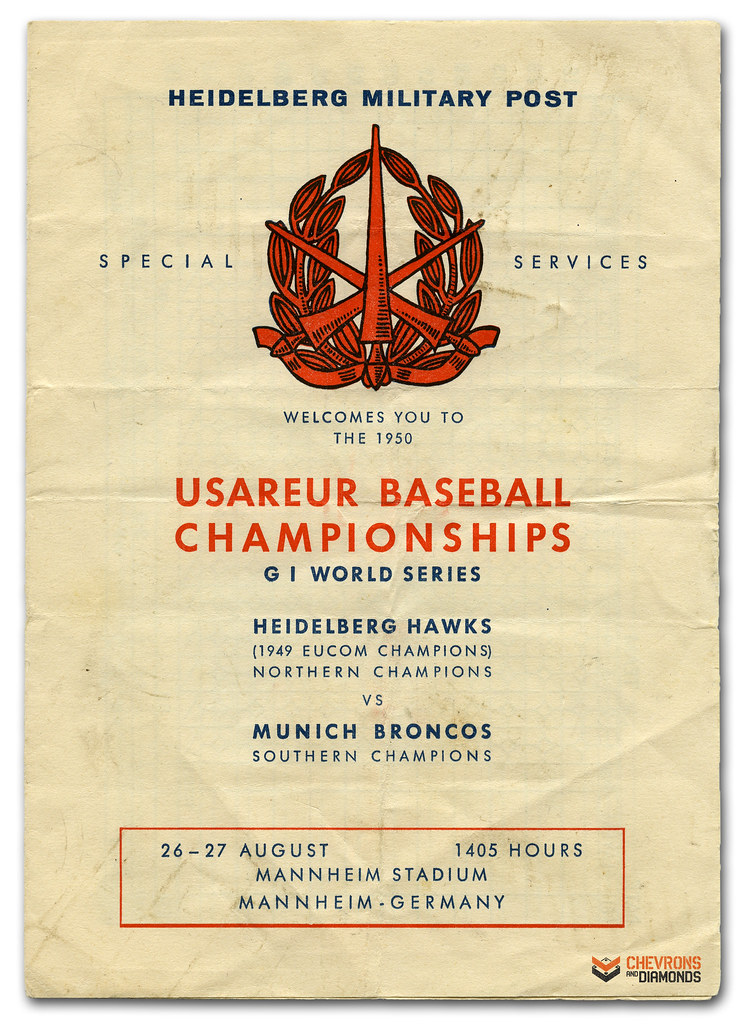
Our scorecard was printed to be used for the series opening game that was tentatively scheduled for either August 26 or 27. Printed on lightweight paper stock, the three color (black, orange, blue) ink is vibrant with a colorful image of the U.S. Army Special Services insignia on the cover. Hosted by the United States Army Europe and Africa (USAREUR) Special Services at Mannheim Stadium, the venue held four of the seven games.
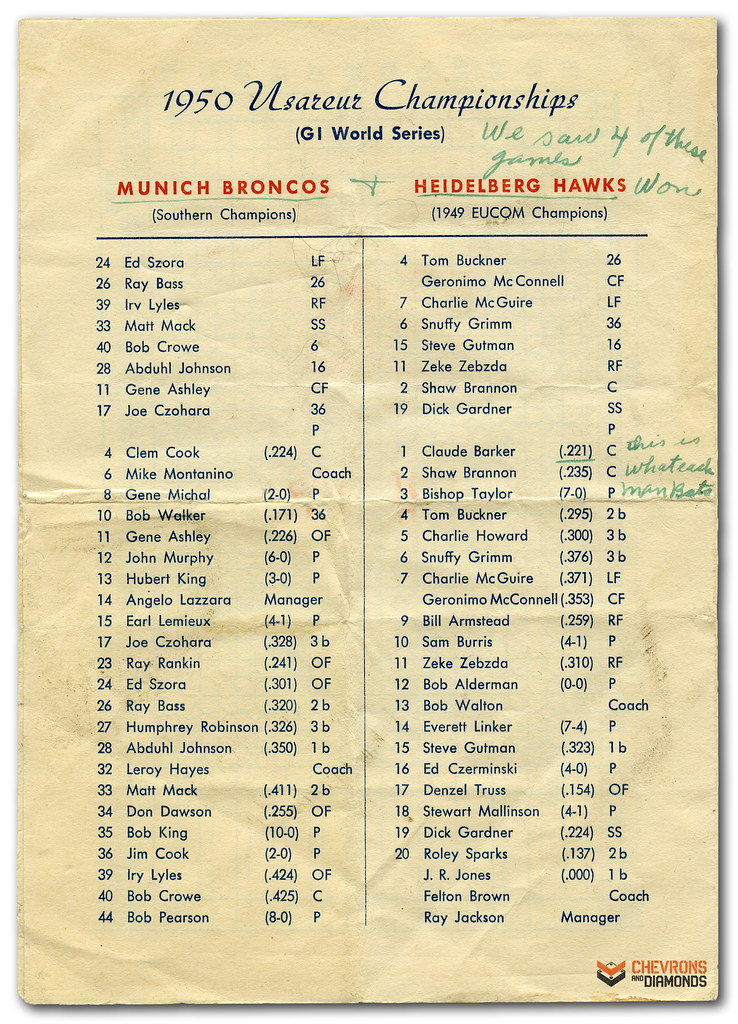
This bi-folded scorecard was printed on a 12 x 8-1/2-inch single sheet with the scoring grids on the inner pages while featuring both teams’ rosters on the back. Despite an extra fold, this piece is in fantastic condition.
[1] Jean Bergman, “Two Armies or One?”, The New Republic (New York, NY), November 6, 1950; p.1.
[2] Jean Bergman.
Acquired from a private collector, September 2024.

 Chevrons and Diamonds