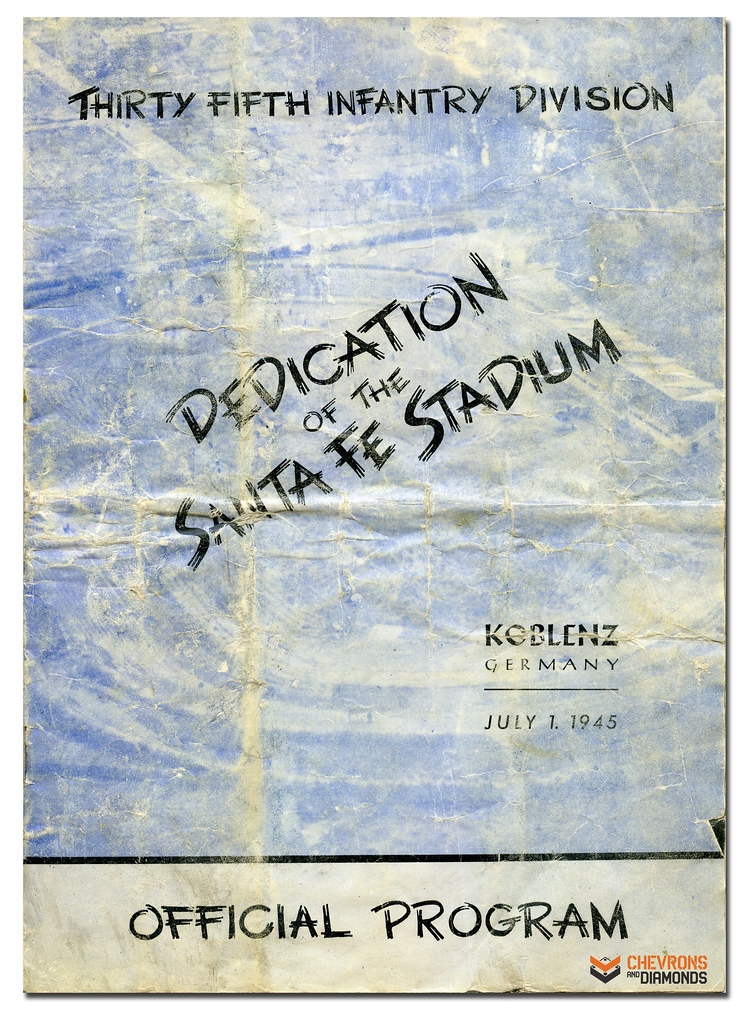
Transitioning from combat operations to a force of occupation, European Theater units utilized athletics competition to provide men with focus of the future of post-war life. Being America’s pastime, baseball was at the center of competition among American military units. “The main purpose after that other war [World War I] was to let the fighting men forget the war and all its sordid mess in a blaze of athletic glory,”[1] the San Antonio Light published on July 2, 1945. For the men of the 35th and 106th Infantry Divisions, which began on July 1 with the first game of the season and the dedication of Santa Fe Stadium at Koblenz, Germany.
The 106th entered combat operations in early December 1944 and saw action through spring 1945 suffered more than 8,600 casualties including 417 killed in action and nearly 6,700 prisoners of war. The 35th landed on Normandy a month after the D-Day invasion participated in the Normandy, Northern France, Rhineland, Ardennes-Alsace, Central Europe campaigns and nearly nine straight months of combat. Seeing a baseball game between the two units as the 15th Army baseball season commenced was a not only a departure from the doldrums of occupation duty, but a distinctly different pace from wartime operations.
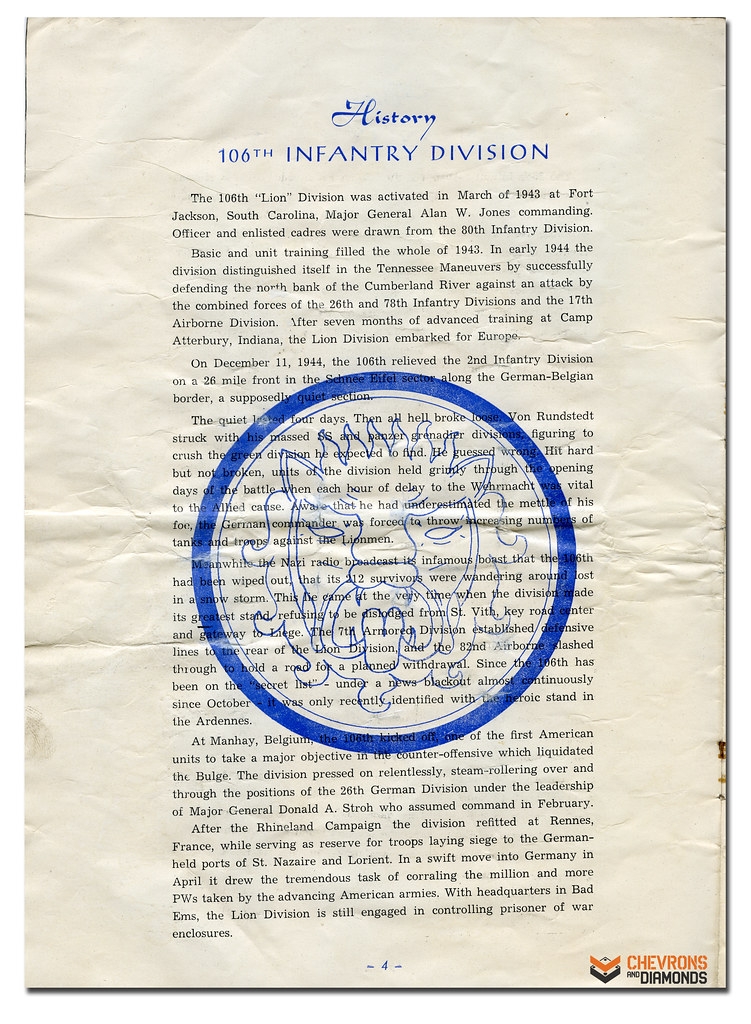

Coinciding with the 15th Army baseball season opening day, the game between the 35th and 106th was played as part of the rededication of Santa Fe Stadium in Koblenz. Constructed in 1920 by the U.S. Army post-WWI occupation forces, the originally named venue, International Stadium, commenced life hosting baseball as well as American football. The San Antonio Light described, “A colorful stadium on an island in the Rhine Rier was rededicated to American army uses Sunday, just 25 years after American occupation forces built it following World War I.”[2]
Download a printable copy of the full scorecard

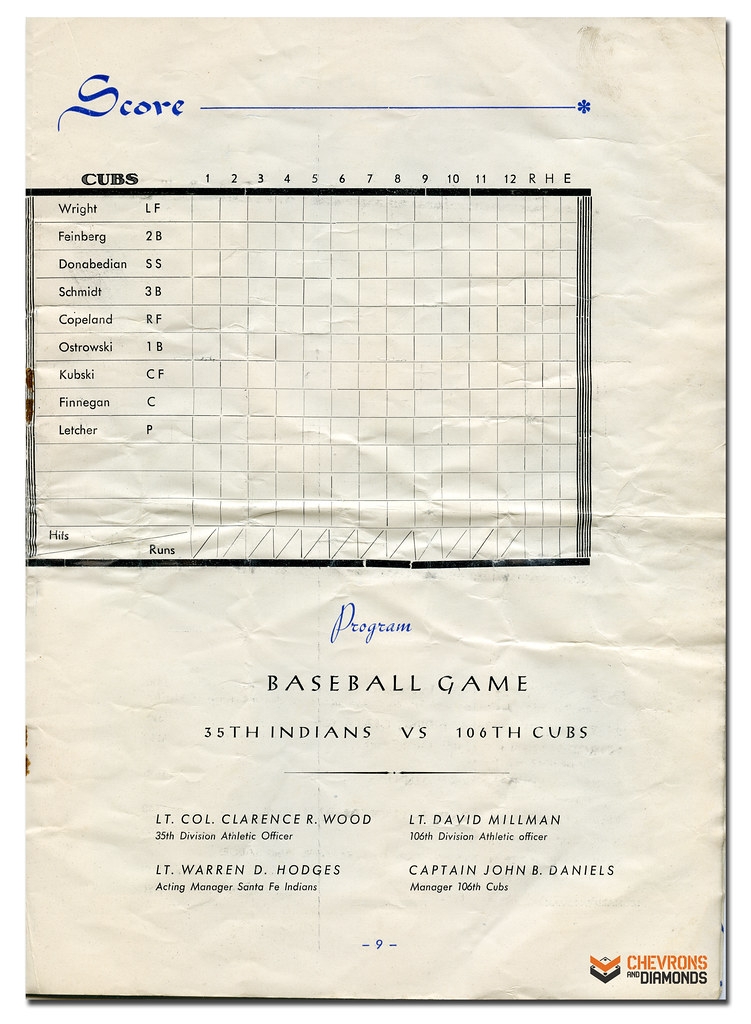
Before the game commenced, Lieutenant General Leonard T. Gerow, commander of the 15th Army, recognized the commendable service of his men and presented War Department citations for battle honors to the following units: 1st Battalion/320th Infantry Regiment; 1st Battalion/134th Infantry Regiment; “C” Company, 134th Infantry Regiment; and 2nd Platoon, “D” Company/134th Infantry Regiment for valor at Mortain and St. Lo and in the Biles River Crossing into Germany. [3]
More than 12,000 men of the 35th Division were in attendance to see the “Santa Fe Indians” down the 106th Division “Cubs,” 5-2. Former St. Louis Cardinals pitcher Corporal Murry Dickson, who pitched in the 1943 World Series before his Army induction, held the 106th to five hits. His teammate, Leonard Novak, a former infielder for the Evansville “Bees” of the class “B” Three-I League, led off the bottom of the first inning with a solo homerun setting the tone for the game. In the seventh inning, Novak crushed his second round-tripper of the game.

European Theater Baseball continued into August as the regular seasons across the continent wound down to commence the various championship rounds, progressing towards the eventual GI World Series in Nuremberg Stadium. But for the 35th, baseball in Europe became a memory as the Division arrived in New York on September 10 and the 106th a month later.
Most notable on the Santa Fe Indians was Murry Dickson, who pitched the last two outs of Game 5 in the 1943 World Series as the Yankees defeated St. Louis, four games to one. He pitched two games in the 1946 World Series against Boston including seven innings of Game 7 in which he held a 3-1 lead with two runners on base before being relieved by Harry Brecheen. Breechen allowed Boston to tie before St. Louis plated the go ahead run in the top of the ninth.
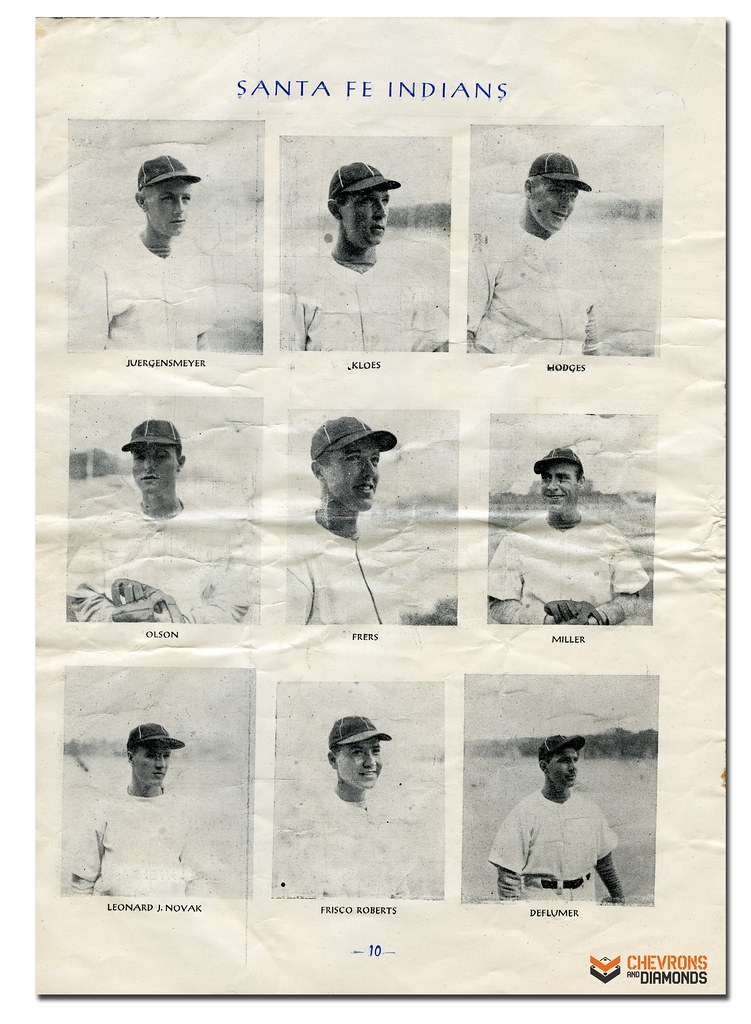
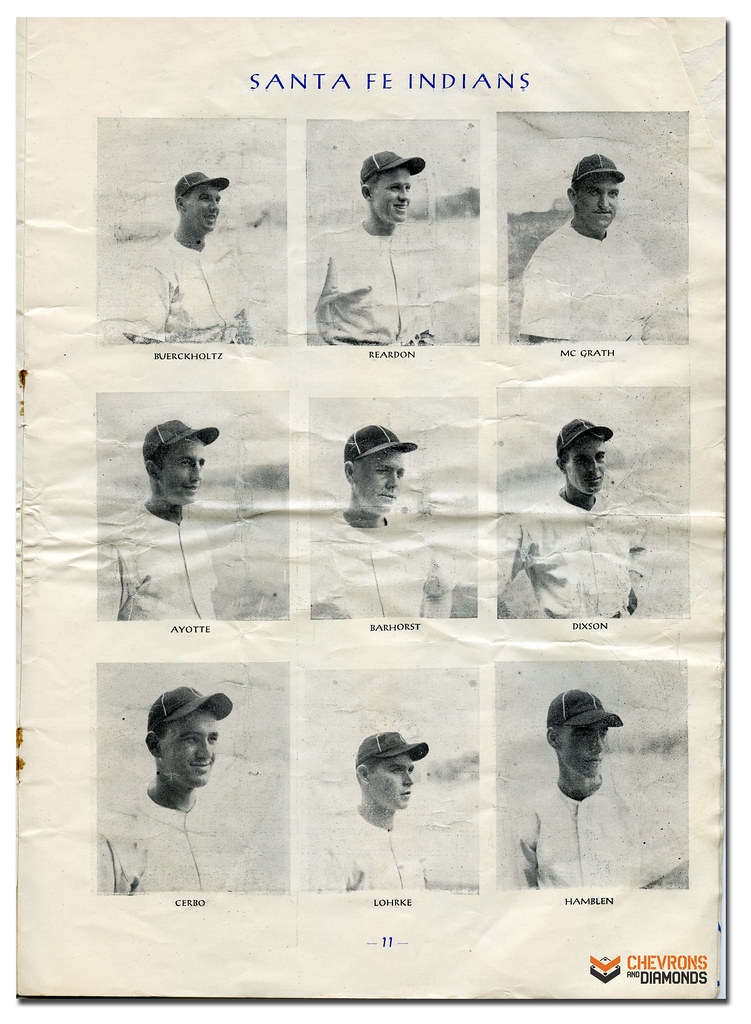
35th Infantry Division “Santa Fe Indians”:
| Player | Position | Former |
|---|---|---|
| Robert J. Ayotte | C | Hartford (EL) |
| Barhorst | ||
| Wilbur Buerckholtz | RF | Columbus (AA) |
| Cerbo | ||
| DeFlumer | CF | |
| Murry Dickson | P | Cardinals |
| Warren R. Frers | 1B | |
| Hamblen | ||
| Hodges | ||
| Juergensmeyer | ||
| Kloes | LF | |
| Jack W. Lohrke | 3B | San Diego (PCL) |
| McGrath | ||
| Miller | ||
| Leonard J. Novak | 2B | Evansville (IIIL) |
| Olson | RF | |
| Reardon | ||
| Frisco Roberts | SS | Johnson City (APPY) |
Jack Lohrke, who made it through the war with the 35th without a scratch, returned to the professional game and a seven-season career in the big leagues. However, a year removed from the VE-Day, Lohrke received the call up to the class “AA” San Diego Padres of the Pacific Coast League on June 24, 1946. Word reached Lohrke as the Spokane Indians team bus was stopped in Ellensburg, Washington, en route to Bremerton for a series. Lohrke headed to meet the Padres by way of Spokane as the bus continued westward toward tragedy. Lohrke was spared certain death as the Indian’s team bus plummeted off the highway down more than 300 feet into a canyon killing nine of the fifteen players.[4]
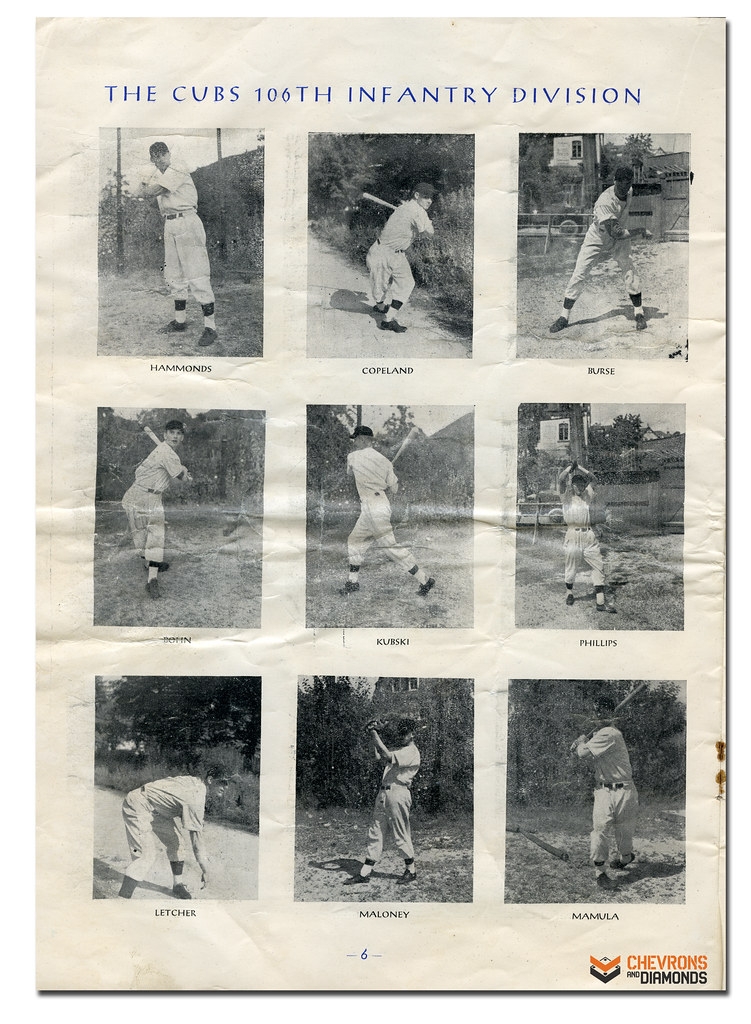
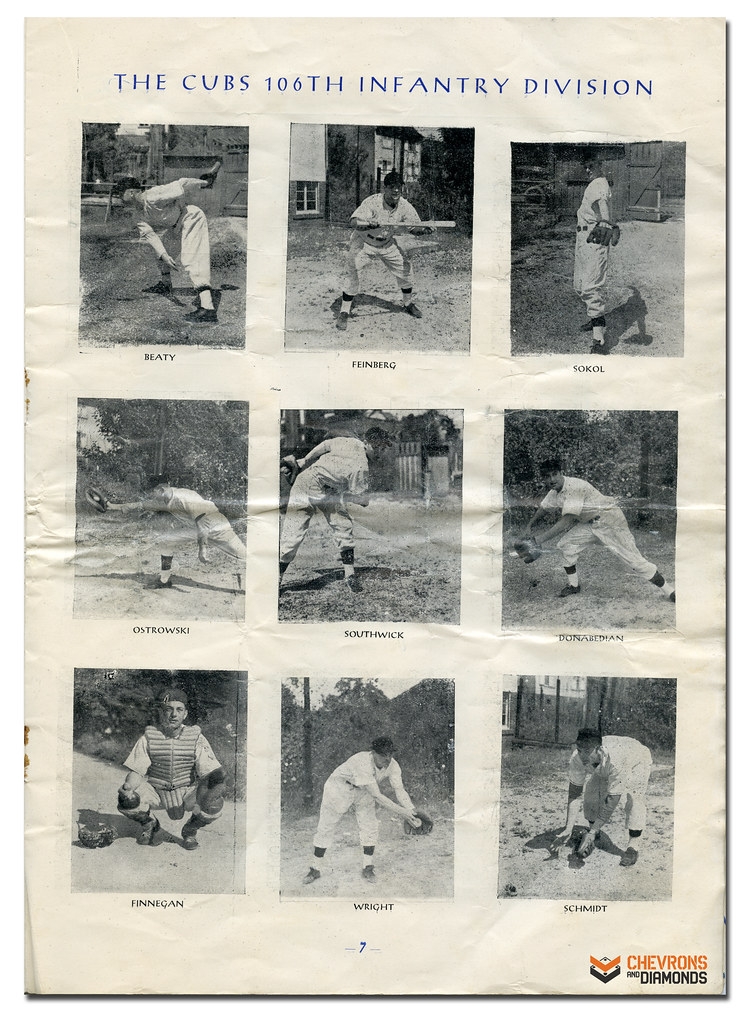
106th Infantry Division “Cubs”:
| Player | Position | Former |
|---|---|---|
| Beaty | ||
| Blake | CF | |
| Bohn | ||
| Brandolini | ||
| Brown | OF | |
| Burse | ||
| Carlin | Secretary | |
| Copeland | OF/Co-Capt | |
| Daniels | Mgr. | |
| Harry Donabedian | SS | |
| Eddie Feinberg | 2B | Phillies |
| Finnegan | C | |
| Hammonds | ||
| Albert A. Kubski | CF/LF | Lynchburg (VIRL) |
| Letcher | P | |
| Maloney | ||
| Mamula | ||
| Ostrowski | 1B | |
| Phillips | ||
| Schmidt | 3B | |
| Sherer | ||
| Sokol | P | |
| Jack Southwick | P | |
| Werner | Trainer | |
| Wright | CF/Co-Capt |
Before the war, Jewish ballplayer Eddie Feinberg, played in parts of 1938 and 1939 seasons with the Phillies before finishing his profession baseball career in 1940 with the class “B” Greenville Spinners of the South Atlantic League
Our program, while complete, has seen better days. Along with heavy wear and creasing, this piece shows signs of water damage and staining. Having been glued into a scrapbook and subsequently removed, the back cover suffered paper separation, tearing and glue.
This scorecard was acquired from an online auction in October 2025.
[1] “Murry Dickson In Form on Rhine,” San Antonio Light, July 2, 1945; p.4.
[2] San Antonio Light
[3] Tom Yarbrough, “134th Units Cited at Game,” Omaha World-Herald, July 2, 1945; p. 7
[4] Eric Vickrey, “Season of Shattered Dreams: Postwar Baseball, the Spokane Indians, and a Tragic Bus Crash That Changed Everything,” Rowman & Littlefield Publishers, Published April 16, 2024

Return to Library of Military Baseball Scorecards, Score-books and Game Programs – ETO
 Chevrons and Diamonds