Standing atop the Ogden Service League’s batting leaders’ list by the end of the season, the Bushnell Army General Hospital nine’s burly first baseman’s Paul Bunyon-like lumber wielding was central to the team’s dominance throughout 1945 league play. Staff Sergeant Richard Juergens’ path to capture the league’s batting crown was circuitous, to say the least.
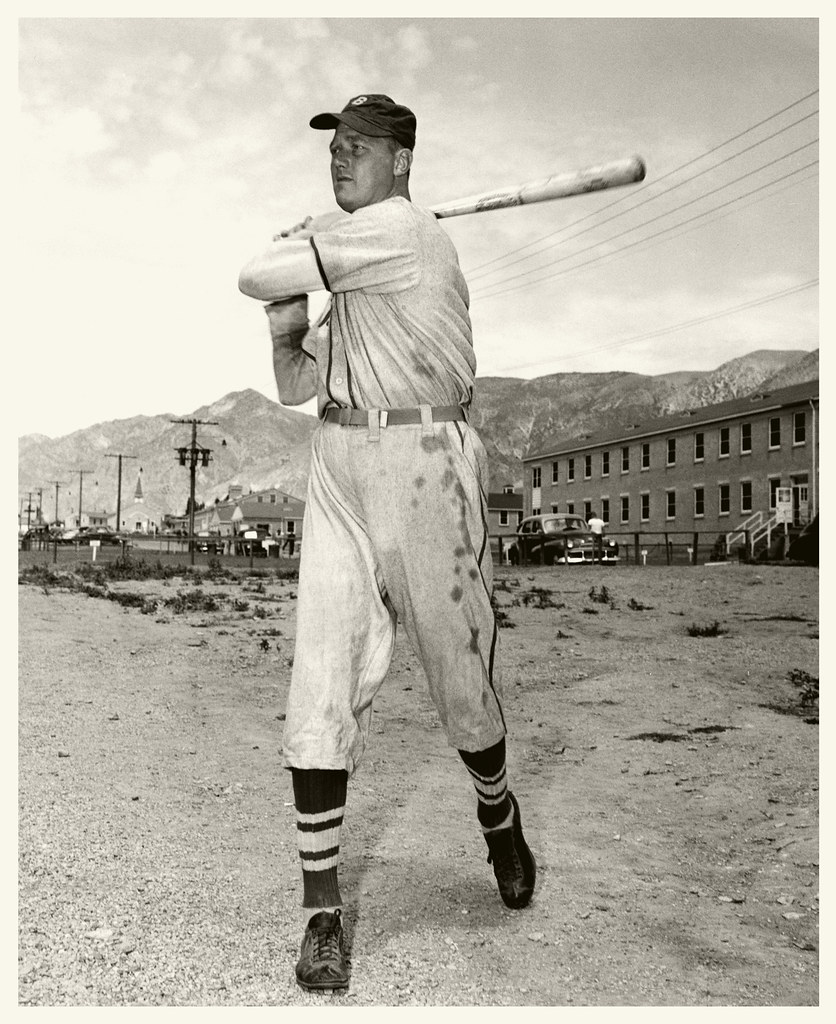
Richard Frederick Juergens, Jr., was no stranger to the baseball diamond. Signed by his hometown American League club out of Cleveland Technical High School and the local sandlots, the 6-foot, 2-inch-tall first baseman was a big man among boys, weighing 200 pounds. He spent his first few professional seasons in the lower levels of the Indians farm system including Findlay in the Ohio State League, Fargo-Moorhead in the Northern League, and the Logan (West Virginia) Indians of the Mountain State League.
Juergens’ 1939 season carried him through three stops, starting with the Fargo-Moorhead “Twins,” before landing at the class “D” Mansfield Braves of the Ohio State League to fill in for their injured first baseman, Harry Siegbert. Once Siegbert was healthy, the Braves were no longer in need of Juergens, who appeared in just seven games.[1] Mansfield optioned Juergens to Logan in July before being sent back to the Twins and was released at the season’s end.[2]
He spent 1940, his last professional season, with the Warren Redskins in the Pennsylvania State Association.
War was raging in Europe and the Far East as Germany and Japan were seizing territory and it was becoming obvious to the American people, despite the overwhelming public objections to fighting wars on foreign soil, that it would be an inevitability to send their sons to fight. The peacetime 1940 Selective Service Act was in full swing, pulling able-bodied young men, including some minor leaguers, into the armed forces by November of that year.[3] Major leaguers Hugh Mulcahy of the Philadelphia Phillies and Detroit’s Hank Greenberg were subsequently among the earliest players to enter the armed forces.
With limited play down on the Indians’ farm, the young first baseman worked out with the major league club in the spring of 1941,[4] but a career in professional baseball was fading for Juergens. Instead of landing a roster spot with the Indians, Juergens answered Uncle Sam’s call and entered the Army on July 11, 1941.[5]
By late 1942, the Allies were on the offensive against Axis powers in the Pacific following the Battle of Midway and in North Africa with Operation Torch. American aerial bombing of German targets in Europe was well underway throughout 1943 as the massive buildup of American forces had started in Britain.
On January 2,1944, Juergens, assigned to the Fourth Infantry Division’s Twenty-Second Infantry Regiment in “C” Company in the First Battalion, was promoted to the rank of sergeant, having spent nearly three years in uniform. The 22nd trained at Fort Dix, New Jersey, Camp Gordon Johnson, Florida and Fort Jackson, South Carolina before arriving once again in New Jersey’s Camp Kilmer. Having staged for troop transport embarkation, the 22nd Infantry sailed for England on January 18 and upon arrival spent the next four months training and preparing for the European offensive against the Third Reich.
On June 6, 1944, the first and second battalions of the 22nd Infantry landed at Utah Beach, 75 minutes after the initial wave, and pushed towards Cherbourg. By nightfall on D-Day, the First Battalion of the 22nd reached the town of Ravenoville, approximately seven miles from the beachhead. A half mile away lay the 22nd Regiment’s objective, a heavily fortified naval gun emplacement.[6]
Crisbecq Battery, a German naval coastal gun emplacement that was part of Germany’s Atlantic Wall fortification, was a concrete and steel casement structure up to ten feet thick. It housed three Czech-designed 21 cm Kanone 39 guns with a range of 17-21 miles. The Crisbecq emplacement was situated two miles inland between the towns of Fotenay-sur-Mer and Saint-Marcouf and was manned by a garrison of roughly 400 Kriegsmarine troops.
As the Allied forces began approaching Normandy for the D-Day landings, the Crisbecq battery commenced firing upon the ships at 5:52 a.m. Despite taking heavy fire from naval gunfire offshore, the Crisbecq battery was still operational, successfully firing on and damaging the American destroyer USS Corry.
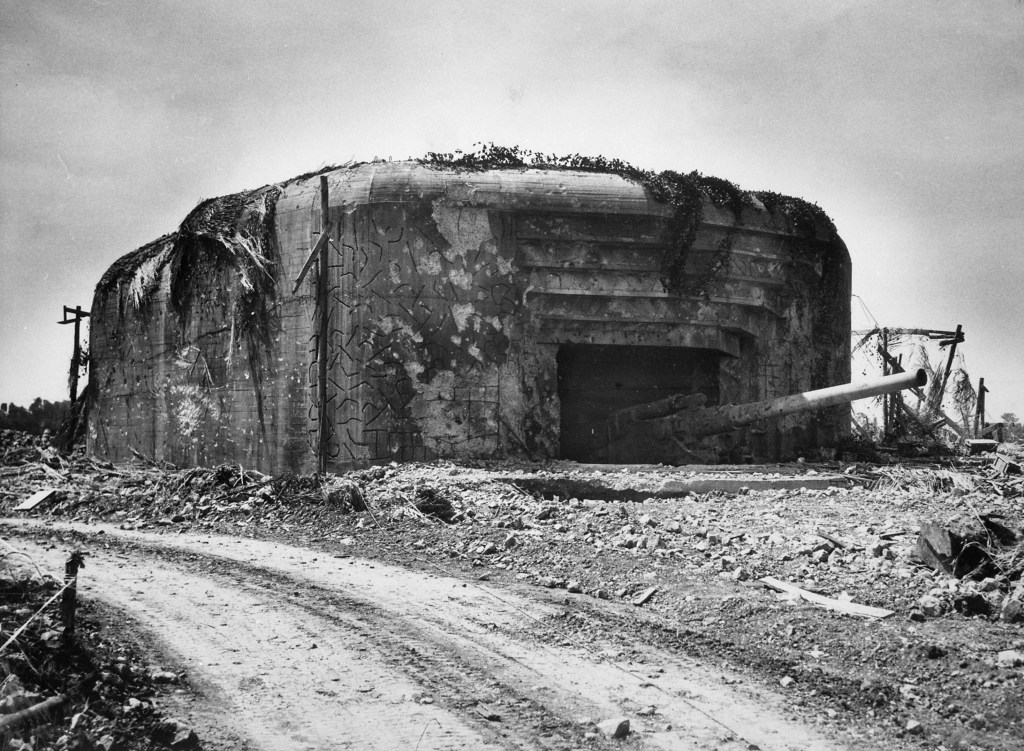
The First Battalion’s initial advance on the battery commenced at 7:00 but was stalled by German counter attacks. After intense fighting including heavy artillery fire, the Americans breeched the perimeter and destroyed the guns by the afternoon of June 8. Sgt. Juergens was wounded in action during the first day of the attack on the Crisbecq Battery.[7]
Five days after being wounded, Sgt. Juergens returned to duty on June 12 and was promoted to the rank of staff sergeant on the 16th. [8]
At 10:00 on June 21, the 22nd Infantry began an assault on enemy positions in the vicinity of Gonneville and Le Theil on the Cotentin Peninsula. The regiment’s objective was to secure the high ground overlooking the Maupertus Aéroport as the battle to take Cherbourg was underway approximately eight miles to the west. During the attack, Staff Sergeant Juergens was hit in his shoulder[9] for his second combat wound of the Normandy campaign.[10]
Some disparity exists between newspaper reports and official Army records regarding an August 16 facial wound sustained by Juergens and further research could provide clarity. The nature of the reported facial wound is in line with the level of reconstructive treatment at the facility where Staff Sergeant Jeurgens was sent.
Juergens’ 1945 club, the Bushnell General Military Hospital nine, was not a conventional service baseball club but rather a component of the Army’s plan to rehabilitate wounded veterans through sports. While some of the game’s greatest stars including Joe DiMaggio, Ted Williams, Stan Musial, Pee Wee Reese and others served part or all their service time in an athletic capacity, including on the diamond, the Bushnell baseball team served an entirely unique purpose.
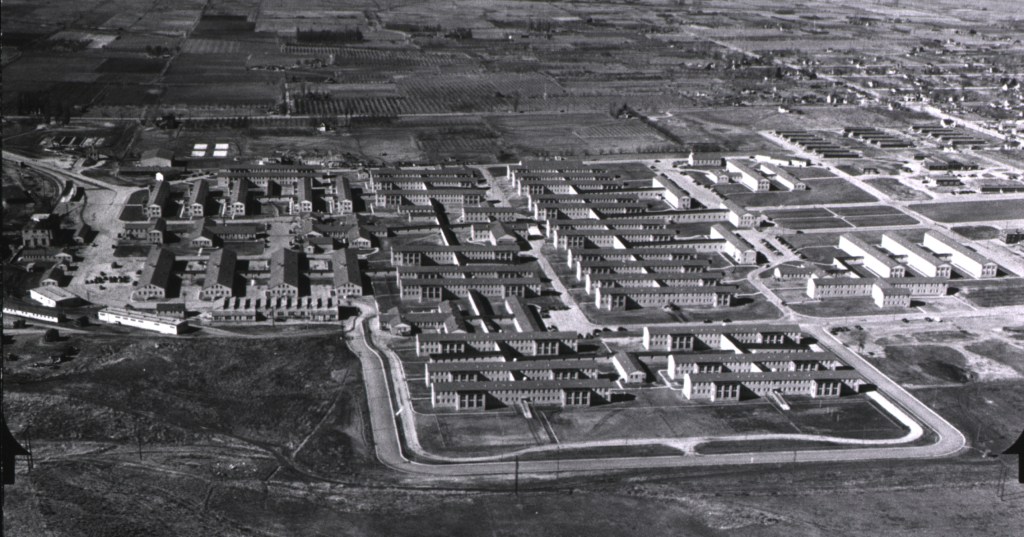
The Bushnell General Military Hospital at Brigham, Utah, was a sprawling campus described as a self-contained city that included utilities, waste water treatment, a fire department, its own well system, churches, theaters, and even its own train station. It treated some 13,000 wounded veterans, helping them to recover, rehabilitate and return to productive civilian life.[11] The massive 235-acre campus was far different from the Army’s general hospitals spread around the country. Opening in October, 1942 and featuring more than 1,500 beds and 60 buildings, Bushnell was innovative with patient care and treatment including the experimental use of penicillin, which resulted in a significantly low death rate.[12]
Thousands of miles from the battlefront, heroic soldiers arrived at Bushnell, engaged in the fight to return to civilian life “as normal human beings rather than as ghastly spectacles reflecting the horrors of modern warfare. They [were] fighting for a chance to become socially independent in the postwar world.”[13]
Bushnell’s plastic surgery ward, similar to those at Walter Reed, Valley Forge (Phoenixville, Pennsylvania), O’Reilly (Springfield, Missouri) and Letterman (San Francisco, California) General Hospitals, provided reconstructive care to rebuild “shattered and mutilated faces,” and “burned and mangled bodies” with the most modern medical equipment and technological advancement at that time.[14] Surgical treatment was only the beginning for the wounded warriors in their efforts to return to some form of normalcy. Post-surgical care and physical therapy helped to prepare for the more intensive rehabilitation efforts.
Bushnell Hospital featured an enormous field house where wounded soldiers, many of whom suffered the most traumatic wounds resulting in the loss of one or more limbs, worked out an hour or more each day. Starting off with prescribed physical drills and exercises, the men would progress to competing in team sports including volleyball and basketball or on gymnastics apparatus.[15]
Athletic competition motivated the men to excel. Amputees, fitted with prosthetics, were just as competitive and driven as able-bodied men. Juergens’ situation was similar. Twice wounded in combat in Europe, he was sent to Bushnell for rehabilitation and soon found himself on the hospital’s diamond.
For Juergens, the 1945 season with Bushnell was a multi-front victory. Not only did the game serve to rehabilitate him from his combat wounds, but it also reignited his pre-war baseball prowess as he guided the All-Stars to the Ogden Service League championship. “Juergens is doing so well with the hickory it’s almost a 50-50 chance he’ll score a hit every time he steps up to the plate. His league-leading batting average is now .476, and most of his hits have been for extra bases.”[16] The team’s roster consisted largely of amateur players but included former minor leaguers Martin Kaelin and Bob Nadler in addition to Juergens.
The league’s brief June-through-August season was divided into two halves, with the split being in mid-July. “Bushnell Hospital baseballers blasted Hill Field 13-to 3 at Brigham City last night to clinch the first half championship in the Ogden Service Baseball league. The Bushnell nine won eight and lost just a single game in the half (season) schedule.” [17]
| Player | Position | Former |
|---|---|---|
| Bacel | ||
| Elmer Bean | OF | |
| Beau | CF | |
| Brigham | ||
| Caldwell | C | |
| Carrell | SS | |
| Churilla | LF | |
| Grimes | C | |
| Holloway | 3B | |
| Richard Juergens | 1B | Fargo-Moorhead (NORL) |
| Martin Kaelin | SS | |
| Lawrence | P | |
| Marchica | RF | |
| Bob Nadler | IF | Sheboygan (WISL) |
| Pfiffner | CF | |
| Stockton | ||
| Thomson | P | |
| Tomaselli | 2B |
By mid-August, as the war in the Pacific was drawing to its bitter end following the atomic bombing of Nagasaki, the hospital nine nailed the second-half season title down. “Bushnell Hospital baseballers celebrated V-J Day Tuesday evening with a 7 to 5 decision over the Railroad Boosters at Brigham City. The victory gave the Brighamites the second half championship of the Ogden Service League.”[18] In addition to Juergens’ offensive onslaught, his teammate Nadler batted .440 to claim the third best average in the league. Bushnell’s league-leading .362 team batting average was bolstered by Bean (.416) and Holloway (.414) along with three Hospitalers who hit above .300.[19]
Juergens’ impressive play with Bushnell did not go unnoticed as the Philadelphia Phillies, amid a 46-win season, scouted the first sacker with the intention of bringing the 26-year-old veteran into their fold. Discharged from the Army on October 6, 1945, Juergens signed a professional contract with Philadelphia and was assigned to their class “B” Interstate League club, the Wilmington (Delaware) Blue Rocks.
Ahead of breaking camp from their Rock Hill, South Carolina spring training site, Juergens was given his unconditional release on April 11, 1946.[20] Not ready to give up on his diamond dream, the veteran signed with the Mount Airy (North Carolina) Graniteers of the class “D” Blue Ridge League under manager Eddie Morgan in May.[21] Most of the Mt. Airy club’s roster consisted of career minor leaguers, though two of Juergens’ teammates were veteran major leaguers. Alfred Lovill “Chubby” Dean spent eight seasons playing first base and pitching in the American League with Philadelphia and Cleveland while Bob Bowman pitched parts of four seasons in the National League with the Cardinals, Giants, and Cubs.
The Graniteers spent most of the 1946 season in front of the four-team league, trading places with Lenoir and Radford as they battled for the championship. Juergens, primarily the team’s starting first baseman, saw action on the hill in three games, tossing seven total innings in relief appearances.
The Graniteers finished firmly in second place, 11 games behind Lenoir, while Juergens’ .276 batting average landed him in the 22nd position on the batting leaders’ list. Mt. Airy’s .278 team batting average was .001 percent higher than second place Lenoir.[22] In Mt. Airy’s 8-7 loss to the Galax (Virginia) “Leafs,” Juergens went zero-for-four but scored two runs in what would be his last professional baseball game.[23]
Richard F. Juergens returned to Cleveland, married, raised a family and worked in the banking industry.[24] He passed away in 2009.[25]
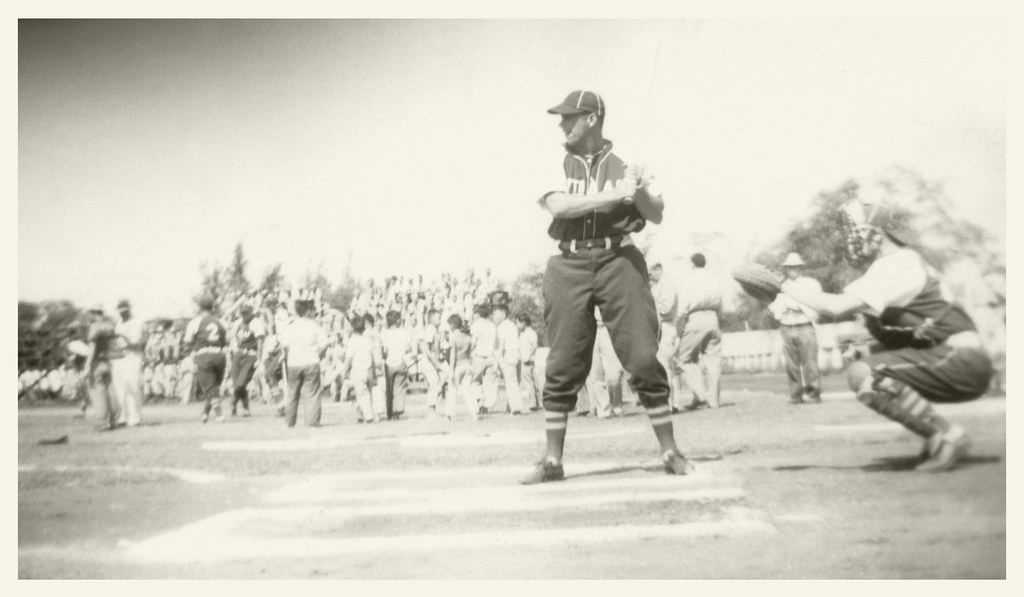
Juergens’ story surfaced following the acquisition of an innocuous vintage photograph showing the sergeant bedecked in heavily soiled flannels in a 1940’s-era baseball hero pose. Fortunately, the original caption slug was still adhered to the verso and provided enough details that afforded in-depth research of Juergens’ service and professional career.
[1] “Braves Play Tiffin In Twin-Bill Sunday,” News Journal (Mansfield, OH) July 1, 1939: p.8.
[2] Richard Juergens, The Sporting News Player Contract Cards: LA84 Foundation Digital Library, accessed November 2, 2024.
[3] Gary Bedingfield, “First To Go!,” Baseball’s Greatest Sacrifice (https://www.baseballinwartime.com/first_to_go.htm), accessed October 21, 2024.
[4] “Twice Wounded Vet Sets Swat Pace In Baseball League,” The Ogden Standard-Examiner, August 9, 1945: p.13.
[5] Enlistment Record, Richard F. Juergens, Jr., National Archives Access to Archival Databases, accessed October 21, 2024.
[6] Michael Belis, “History of 22nd Infantry Regiment ‘Regulars By God,’” 22nd Infantry Regiment Society (https://22ndinfantry.org/regimental-history), accessed November 2, 2024.
[7] Théophile Odaert, Sergeant Richard F. Juergens, Jr., 35026937, 22nd Infantry After Action Reports.
[8] Théophile Odaert.
[9] “Twice Wounded Vet Sets Swat Pace In Baseball League,” The Ogden Standard-Examiner, August 9, 1945: p.13.
[10] Théophile Odaert.
[11] “Bushnell General Military Hospital,” Utah State University: Digital Exhibits (http://exhibits.usu.edu/exhibits/show/bushnelldays/bushnellgeneral), accessed October 21, 2024.
[12] Aubrey Glazier, “Bushnell Military Hospital,” Intermountain Histories (https://www.intermountainhistories.org/items/show/86), accessed October 21, 2024.
[13] John Stewart, “Plastic Surgery Rebuilds Battle Mutilated Veterans,” The Neosho Daily News (Neosho, MO), May 8, 1945: p.4.
[14] John Stewart.
[15] Doug Lovelace, “Armless, Legless War Vets Turn To Sports,” The Daily Tribune (Wisconsin Rapids, WI) May 7, 1945: p.6.
[16] Ibid.
[17] “Bushnell Nine Wins First Half Service Loop Flag,” The Ogden Standard-Examiner, July 14, 1945: p.3.
[18] “Bushnell Is Champion,” The Ogden Standard-Examiner, August 15, 1945: p.10.
[19] “Juergens Is First in Service Loop,” The Ogden Standard-Examiner, August 5, 1945: p. 10.
[20] Jack Gibbons, “Blue Rocks To Break Camp At Rock Hill On April 22,” The Morning News (Wilmington, DE), April 11, 1946: p.16.
[21] Richard Juergens, The Sporting News Player Contract Cards: LA84 Foundation Digital Library, accessed November 2, 2024.
[22] “Blue Ridge League,” News and Record (Greensboro, NC) September 8, 1946: p.32.
[23] “Mount Airy Loses Finale to Galax,” Winston-Salem Journal, September 9, 1946: p.7.
[24] Ohio State Death Records, Ancestry.com, accessed November 2, 2024.
[25] BIRLS, Ancestry.com, accessed November 2, 2024.
 Chevrons and Diamonds
Leave a comment