
The United States entry into World War II was a response to a national crisis that was unprecedented at that time. Once the shock began to subside, the angered response was rapid as Americans began to arrive at military recruiting stations throughout the country. As devastating as the 9/11 attacks were on the United States, the corresponding rise to take up arms was minuscule by comparison and only a small fraction of stateside Americans lent hands to support the veterans or their families. In 1942, the idea of the entire nation pulling together with singularity in pursuit of victory over a common enemy meant that all Americans would need to participate even if they couldn’t serve on the battlefield.
During World War II, Hollywood was an active participant in the war effort. Actors, writers, directors, cinematographers and producers contributed much like the rest of the nation – they enlisted and served. Still others participated by creating troop training films, documentaries and other audio-visual aids used to instruct and inform our service members. Entertaining troops during WWII was a privilege and honor for members and employees of Hollywood, many of whom would participate in the United Services Organization’s (USO) traveling entertainment shows.

The USO was synonymous with legendary actor/comedian Bob Hope. Before Hope traveled the globe with his shows, another comedian and actor set the tone for Hope and the USO. Joe E. Brown’s career emerged from the silent film era as he appeared in dozens of motion pictures before he transitioned to the small screen later in life. Brown had a passion for the game of baseball that paralleled his patriotism and desire to serve (though he was too old at age 50 when the U.S. was pulled into WWII). Both of Brown’s sons enlisted to fight. Brown’s son Donald was killed in a crash of the A-20 Havoc he was piloting near Palm Springs, California on October 8, 1942 furthering his drive to help troops however, he could.

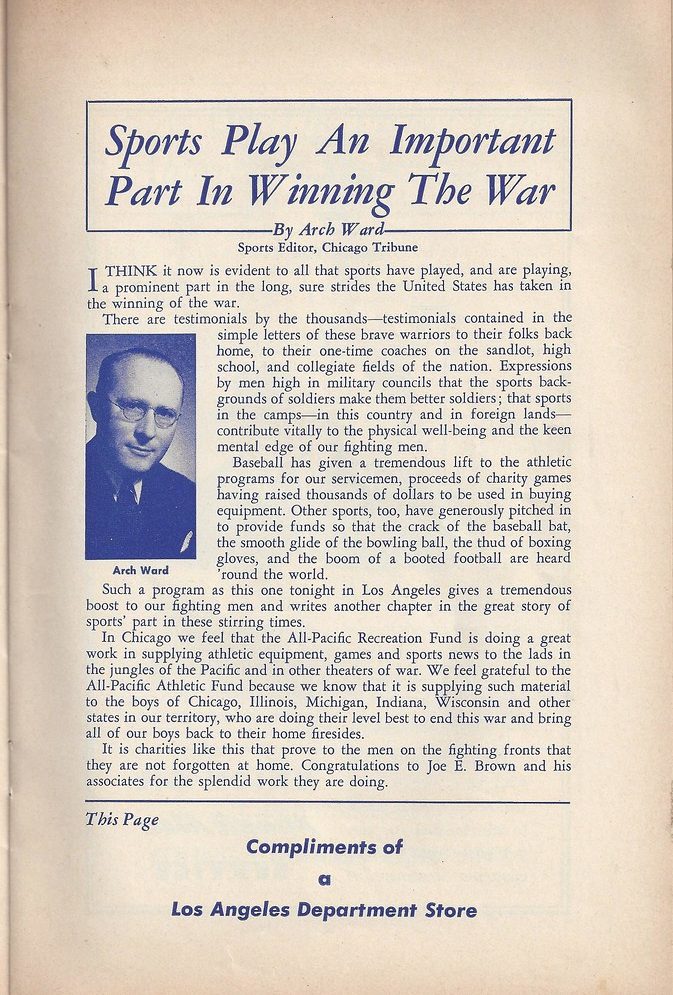

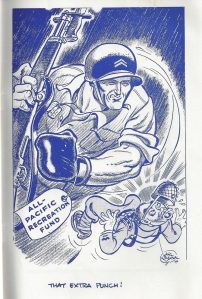
In 1943, Joe E. Brown founded the All Pacific Recreation Fund, “the purpose of which,” according to the organization was to, “make life just a little more livable for our boys who are far from home and all of its comforts and conveniences and fun. Just to be able to choose up sides and stage an honest-to gosh ball game with honest-to gosh bats, balls and gloves makes the far-flung islands and strange lands seem a mite closer to home for these kids. Even to read about sports helps – but when equipment is available, it’s much more fun and relaxing actually to participate. And that’s the purpose of the All Pacific Recreation Fund, to provide the utensils for play.” Similar to Clark Griffith’s Professional Base Ball Fund (see Ted Williams: BATtered, Abused and Loved) during WWII (and his earlier Ball and Bat Fund from World War I), Brown’s organization focused on providing equipment directly into the Pacific Theater of Operations.
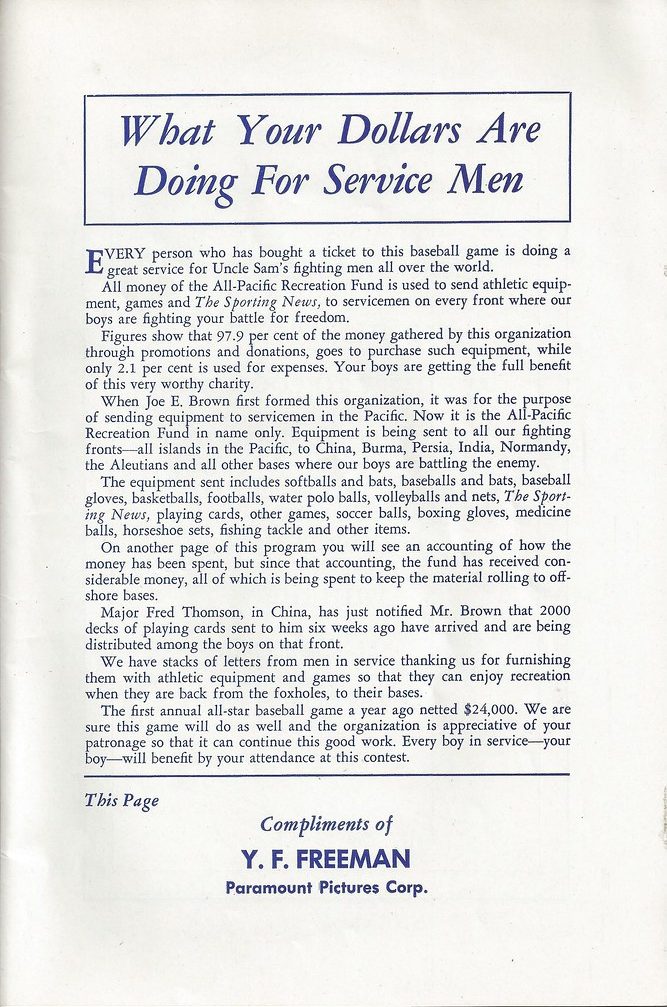
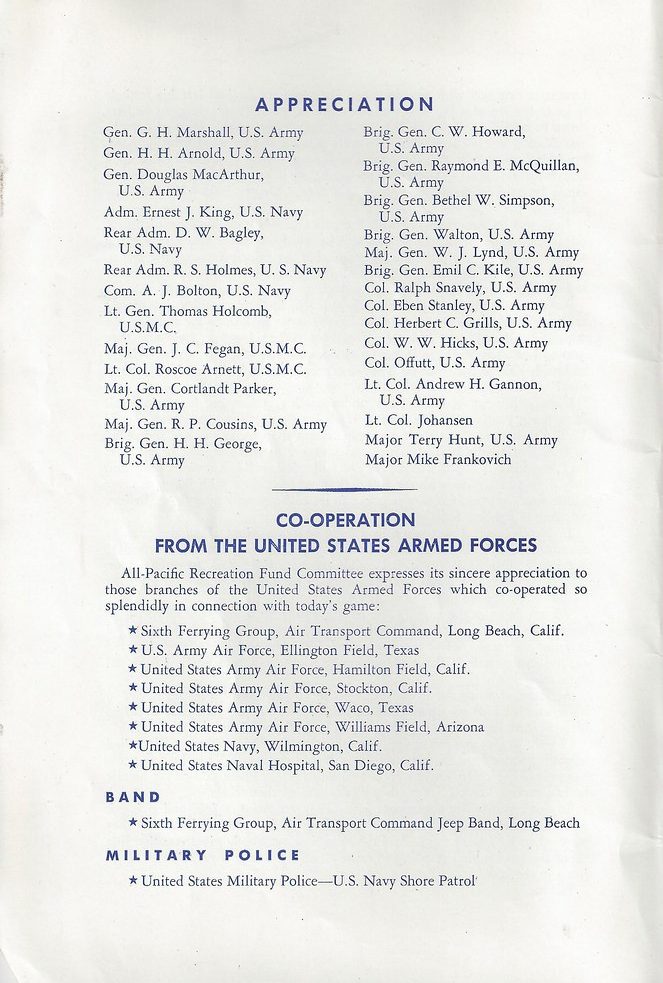
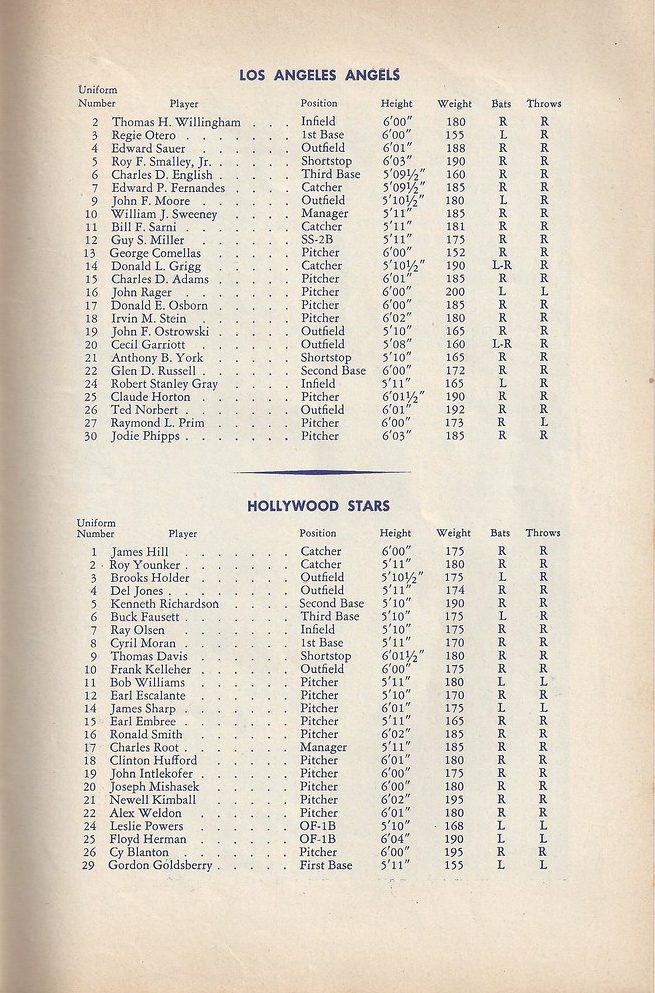
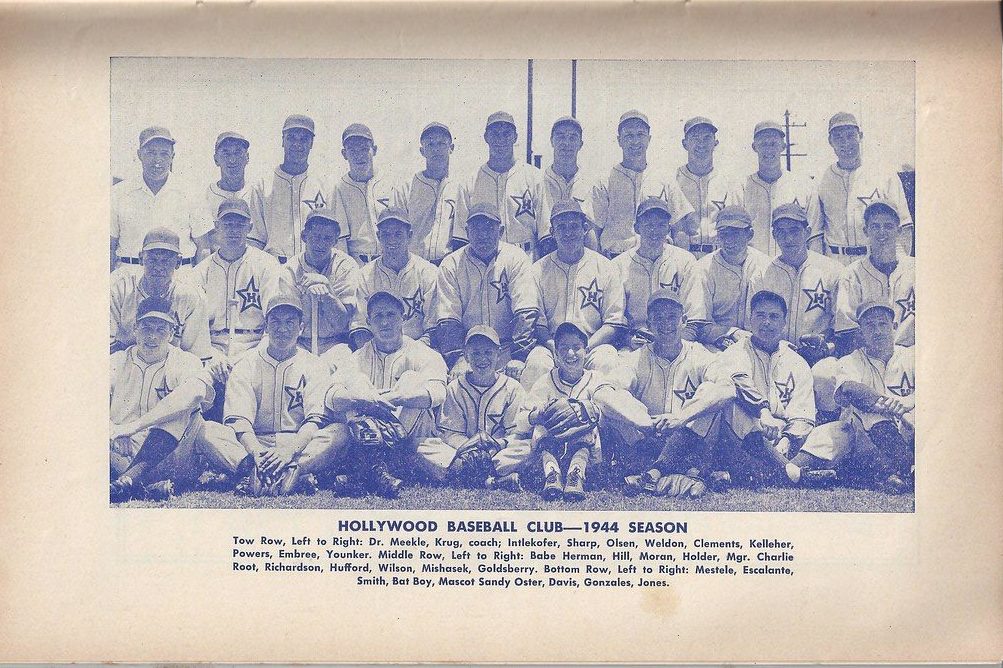
By 1944, all-star games were almost a common event for baseball fans as they were a foundational tool used by several organizations to raise capital for various service member needs, including sports equipment and offsetting their financial hardships (through Army and Navy Relief Societies). On August 26, the All Pacific Recreation Fund hosted a game between service all stars and both the Hollywood Stars and Los Angeles Angels, of the Pacific Coast League (PCL). The roster of the service all-stars featured a line-up of soldiers, sailors and airmen who prior to the war, were professional ball players, several of whom had major league experience. What made this game unique was that the two PCL teams would split the game – each team playing four and a half innings against the service members who were drawn, rather than across the country, from the Southwest region of the U.S.

With the impending close of June, 1942, the ranks of the United States armed forces were still building up to meet the demands of a multi-theater war while celebrating substantial morale (Doolittle Raid) and strategic (Battle of Midway) victories. Professional ballplayers were pouring into the ranks, though some of the bigger names (such as Ted Williams and Doe DiMaggio) remained with their ball clubs for the 1942 season. On the heels of a successful June 26 fund-raising exhibition game between the Yankees, Giants and Dodgers and in preparation for the upcoming Major League All-Star Game, a game that pitted the victors (which ended up being the American League All-Stars) against an assemblage of actively-serving ball players from the armed forces (see: No Amount of Winning Could Ever Offset a Harsh Loss for Mickey Cochrane). The success of the fund-raising effort of this game ($71,000 was raised in support of the Army-Navy Relief and the Ball and Bat fund) set a precedence of charity exhibition games throughout the war.
The following year, charity exhibition baseball games were almost commonplace within the major and minor leagues. Joe E. Brown’s All Pacific Recreation fund staged their first Service All- Star Game on August 21 (1943) that matched the PCL’s Angels and Hollywood Stars against Service All-Stars (a roster that included future Hall of Fame players: Joe DiMaggio, Red Ruffing and Ted Lyons) at Los Angeles’ Wrigley Field, before a crowd of more than 21,000 fans. DiMaggio led the service stars’ hit parade going 4 for 4 with two home runs as the PCL clubs lost, 8-2. The game netted $21,000 for the fund and encourage Joe E. Brown to repeat the event in the following year.
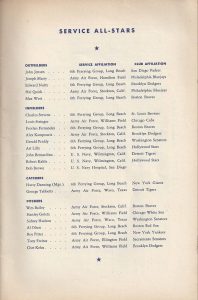
The programs that were created for these games are, by far, the most substantive of those from the wartime military games (at least of those within the Chevrons and Diamonds collection, so far). Not unlike traditional professional game programs, these All Pacific Recreation Fund books have several pages dedicated to paid advertising and identifying sponsors and volunteers who worked to make the games happen. The 1944 Service All-Stars roster has some veterans from the 1943 squad (such as Chuck Stevens, Harry Danning, Nanny Fernandez, Joe Marty and Max West) and the results against the Angels-Stars teams was the same as the previous year.
| Player | Position | Command Location | Club Affiliation |
|---|---|---|---|
| Wes Bailey | P | Army Air Force, Stockton, California | Boston Braves |
| John Beradino | IF | U.S. Navy, Wilmington, California | Detroit Tigers |
| Bob Brown | IF | U.S. Navy Hospital, San Diego, San Diego | None |
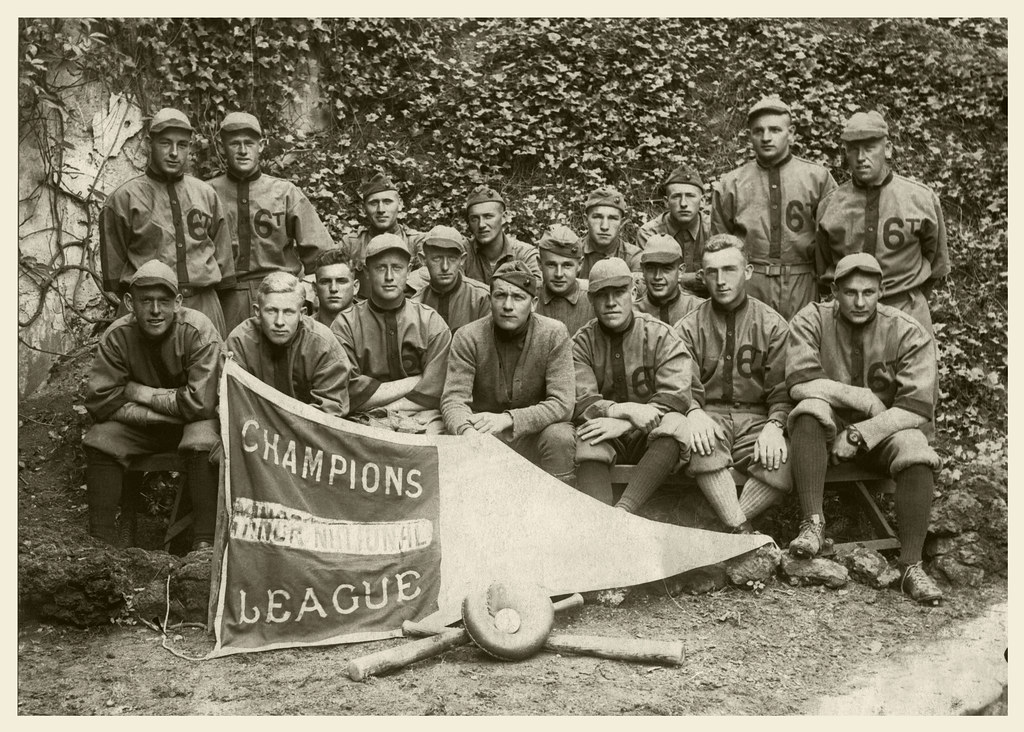
| Harry Danning | C, Mgr | 6th Ferrying Group, Long Beach, California | New York Giants |
| Froilan “Nanny” Fernandez | IF | 6th Ferrying Group, Long Beach, California | Boston Braves |
| Tony Freitas | P | Army Air Force, Ellington Field, Houston, Texas | Sacramento Senators |
| Stanley Goletz | P | Army Air Force, Williams Field, Chandler, Arizona | Chicago White Sox |
| Sidney Hudson | P | Army Air Force, Waco, Texas | Washington Senators |
| John Jensen | OF | 6th Ferrying Group, Long Beach, California | San Diego Padres |
| Robert Kahle | IF | U.S. Navy, Wilmington, California | Hollywood Stars |
| Alex Kampouris | IF | Army Air Force, Stockton, California | Brooklyn Dodgers |
| Chet Kehn | P | Army Air Force, Williams Field, Chandler, Arizona | Brooklyn Dodgers |
| Art Lilly | IF | 6th Ferrying Group, Long Beach, California | Hollywood Stars |
| Joseph Marty | OF | Army Air Force, Hamilton Field, Novato, California | Philadephia Bluejays |
| Edward Nulty | OF | 6th Ferrying Group, Long Beach, California | Brooklyn Dodgers |
| Al Olsen | P | 6th Ferrying Group, Long Beach, California | Boston Red Sox |
| Roy Pitter | P | 6th Ferrying Group, Sacramento, California | New York Yankees |
| Gerald “Gerry” Priddy | IF | 6th Ferrying Group, Long Beach, California | Washington Senators |
| Hal Quick | OF | Army Air Force, Stockton, California | Philadephia Bluejays |
| Charles “Chuck” Stevens | IF | 6th Ferrying Group, Long Beach, California | St. Louis Browns |
| Louis Stringer | IF | Army Air Force, Williams Field, Chandler, Arizona | Chicago Cubs |
| George “Birdie” Tebbetts | C | Army Air Force, Waco, Texas | Detroit Tigers |
| Max West | OF | 6th Ferrying Group, Long Beach, California | Boston Braves |
The August 26 All Star Game provided a near-midpoint break for the Los Angeles and Hollywood teams during their seven-game series. In addition to the exhibition game, time was donated by the umpires, ushers and even the vendors in order to maximize the event for charity. Even the Angels’ President, Don Stewart donated the use of Wrigley Field as 100% of the game’s proceeds (totaling more than $35,000) went to the cause. $9,000 was raised just from the same of the game’s program.

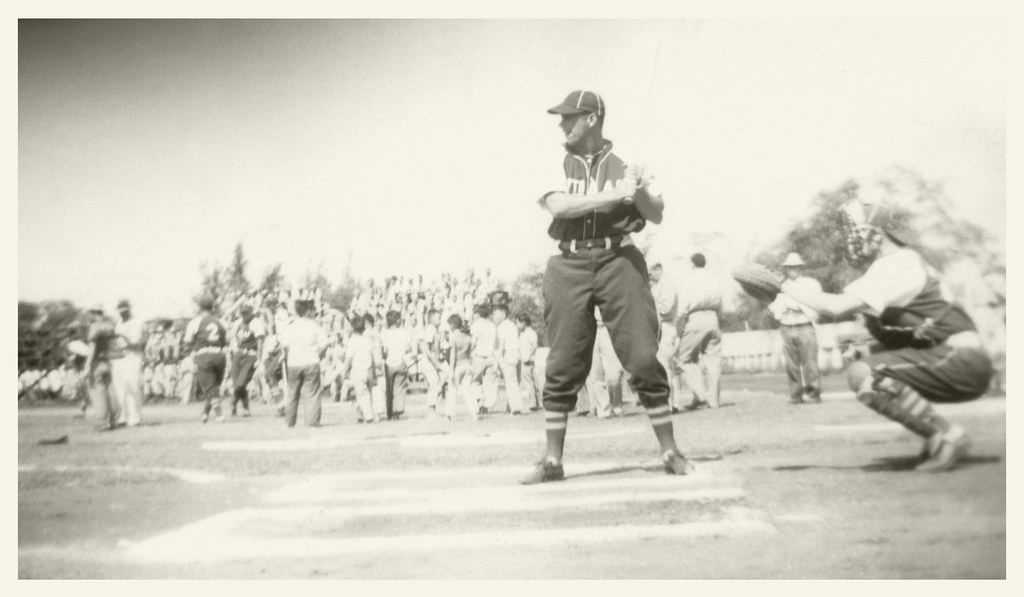
The home half of the frames were split between the Angels (first 4-1/2 innings) and the Stars, for the remaining innings. When the Angels surrendered the game to Hollywood, the score was already out of reach (11-5). In the top of the third, the service stars plated eight runs with the major league power dealing a crushing blow to the Pacific Coast Leaguers. Joe Marty tallied 3 hits (including a triple while Al Olsen, Stan Goletz. Wes Bailey and Tony Frietas pitched for the Service Stars in front of a paying crowd of 7,548 proving to be too much for the Angels and Stars as 16-6 was the final tally.
The program from the August 26, 1944 game is printed on satin, lightweight paper stock and though it appears to be in good condition, there is some substantial wear on the front cover. The most invaluable aspect of this program lies not solely with the aesthetics but in documenting the service member ball players’ progression through the war.
Hopefully, we can source the 1943 All Pacific Recreation Fund program to round out the collection and to properly document the games and the participants.
 Chevrons and Diamonds
Leave a comment