As I hinted in last week’s article, the influx of artifacts into the collection has been nothing short of overwhelming over the course of the last few months. The three uniforms (yes, there are two others that arrived previously and in addition to the WWII Coast Guard set) have yet to be fully documented and researched but they were on display at our public event last month. Less conspicuously unveiled and shown at the Armed Forces Recognition display were a handful of “new” World War II military baseball scorecards.
Aside from baseball’s fluidity in its continual change from batter-to-batter and inning-to-inning, teams are in a constant state of alteration as managers and general managers work tirelessly to field a roster of players that can match up well against their opponents on any given day. For the casual observer, a team manager merely drafts line-up cards, gives direction to the players and batters throughout the game as he maneuvers his team like chess-master, making substitutions and pitching changes to keep his players best aligned against his opponent. An outstanding manager not only addresses the needs of the present game but how his team will be matched up against his future opponents in the next week and even the next month. Major Leagues (and, to some extent, minor leagues) have been well documented as to the roster changes and game line-ups affording researches with an easy tool to follow a player’s professional career. The same cannot be said about the game within the armed forces.
Roster management must have been a bit of a nightmare for military team managers during WWII as the needs of the military superseded the needs of a base or command team. At any given moment, a player could be transferred away to fill a need without notice to the team manager. Tracking players on these service teams’ rosters is a monumental task. Apart from the occasional box score contained within a base or command newspaper or the Sporting News or other civilian news source, rosters largely no longer exist for wartime baseball teams, leaving present-day researchers to piece them together.
Baseball scorecard collectors are off the mainstream of baseball memorabilia collectors though it seems that more people are discovering these historically affordable pieces of baseball history. A scorecard offers a snapshot in time with that day’s roster alignment for the two opposing teams. If a major or minor league game scorecard lacks a date, a researcher is able to use the rosters to reveal the approximate or even the precise date on which the game was played. Another draw for collectors is the aesthetics and artwork that is commonly present, especially with cards from the Golden Era of the game. Apart from the functional aspect (keeping score) the illustrations and photography that can be found adorning the covers and pages of these pieces can be bright and colorful while offering a window into the past.
With the influx of professional players into the armed forces and onto service team baseball rosters during WWII and the audiences that the teams played to and the overall purpose for many of the games (fund-raising), it became a necessity for organizers to produce and print scorecards for the attendees. In most instances, the venues for service games were relatively small which would limit the production of these pieces further reducing the chances of surviving copies.

When a scorecard dating from June 26, 1944 for a fund-raiser (All-Pacific Recreation Fund) game hosted by the Pacific Coast League’s San Diego Padres pitted against the U.S. Army Air Forces (USAAF) 6th Ferrying Group of the Air Transportation Command (ATC), I was excited at the prospect of gaining some insight into the service leagues of Southern California. To date, I have been limited to piecing together rosters from scant story details in the Sporting News that are merely snippets of game narratives regarding the 6th Ferrying Group or any other team that played in their league, which drove me to pursue the online auction listing for the scorecard. Sadly, I was outbid and lost the auction.
Days later, another (different) 6th Ferrying Group scorecard was listed by the same seller. This version was from a game played between the ATC team and the San Bernardino All Stars and played at Perris Hill Park which was, no doubt, the home field of the All Stars (the ball park still stands and is the home field for the California State University, at San Bernardino baseball team and has been renamed Fiscalini Field). I quickly placed another sniped bid only to lose out a second time. Despite my discouragement, I ended up receiving the scorecard (albeit one in well-loved condition) as part of another item from the seller of the previous two scorecards.

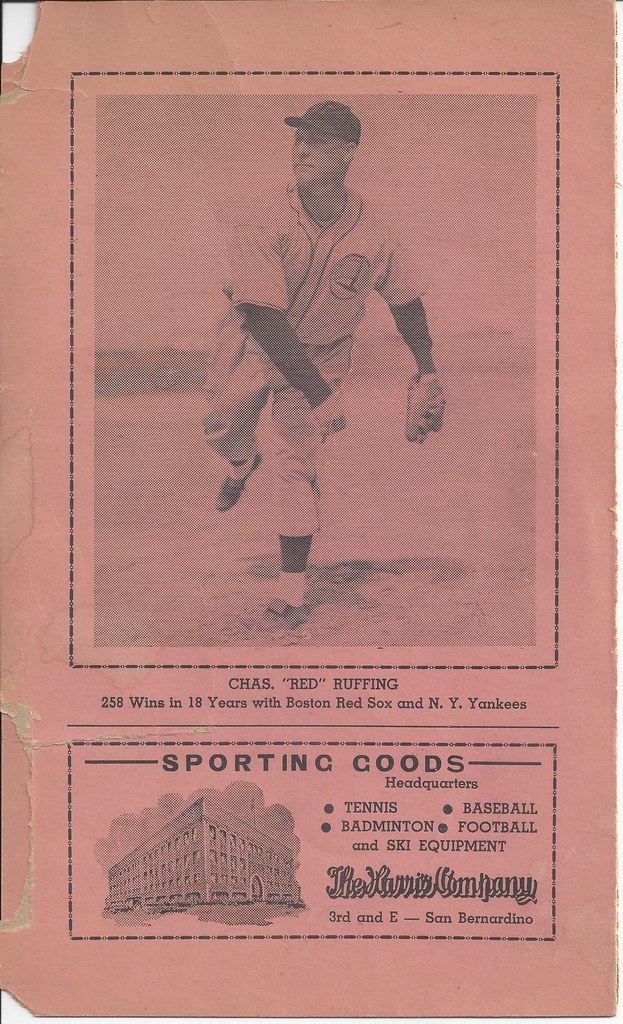
I spent little time carefully removing the card from the package before I opened the the folded single sheet, moving directly to the rosters. Seeing the 6th Ferrying Group’s list of players, I quickly noted the men who had major league experience and began to work through the other names in search of professional ball-playing experience. Prior to owning this scorecard, the only 6th Ferrying Group team members that were discoverable were Chuck Stevens, Nanny Fernandez, Max West, Walter Loos, Harry Danning and Red Ruffing. Ten new names (seven with prior pro experience and one who went on to play professionally after the war). filled out the roster and opened the door to new research.


6th Ferrying Group Roster (major leaguers in bold):
| Name | Position | Former Team |
| Art Lilly | 2B | Hollywood Stars |
| Chuck Stevens | 1B | Stl. Browns |
| Nanny Fernandez | SS | Boston Braves |
| Max West | CF | Boston Braves |
| Harry Danning | CF | NY Giants |
| Ed Nulty | LF | Montreal Royals |
| Swede Jensen | RF | San Diego Padres |
| Walter Loos | 3B | Cincinnati |
| Red Ruffing | P | NY Yankees |
| Hub Kittle | P | Oakland Oaks |
| Ollie Olsen | P | San Diego padres |
| Roy Pitter | P | Newark Bears |
| Willie Werbowski | P | Semi-pro |
| Woody Bell | OF | San Antonio Missions |
| Ike Wise | LF | Semi-pro |
| Chas. Mowrer | LF | Semi-pro |
The 6th Ferrying Group team roster is a goldmine but the discovery isn’t limited to these 16 men. The San Bernardino All Stars is nearly impossible to locate the commands from which the roster was constructed, leaving plenty of opportunity for research. Following a quick baseball search, I was successful in identifying eight of the players on the roster of which two played in the major leagues prior to their wartime service.
San Bernardino All Stars(major leaguers in bold):
| Name | Position | Former Team |
| Don Rosselli | 2B | |
| Norman De Weese | LF | |
| Art Shoap | 1B | LA Angels |
| Frank Kerr | C | |
| Don Lang | 3B | Cincinnati |
| George Wiedemann | RF | |
| H. Munoz | SS | |
| Carl Sepulveda | CF | |
| Ed Chandler | P | Pocatello Cardinals |
| Walter Ripley | P | Boston Red Sox |
| Chas. Harris | P | |
| Simon Martinez | P | Oakland |
| Bill Molyneaux | OF | Louisville Colonels |
| Lefty Watson | OF | |
| Doug Slamer | LF | |
| Clyde List | C | Brainerd Blues |
| Bill Sarni | C | LA Angels |
In addition to researching the names on both rosters, pursuing a box score the amount of money that the was raised from the game would be a fitting punctuation to place upon this scorecard discovery.
References:
- Antique Baseball Scorecards – justcollecting.com
- Collectible Baseball Programs and Scorecards – collectorsweekly.com
- Baseball Programs and Scorecards – Jeff Figler, Collectors Journal
 Chevrons and Diamonds
Leave a comment