After Luzon was liberated from the oppressive occupation by Imperial Japanese forces, it took just weeks for baseball to return to the region and the confines of Rizal Memorial Baseball Stadium. Until the Battle of Manila fought through the streets of the city and in even within the baseball stadium, Rizal served as a garrison for Japanese troops.

Baseball was first played at the battle-scarred ballpark on April 1, 1945 following a monumental effort to restore the diamond from the artillery and mortar-shell craters to make the surface suitable.
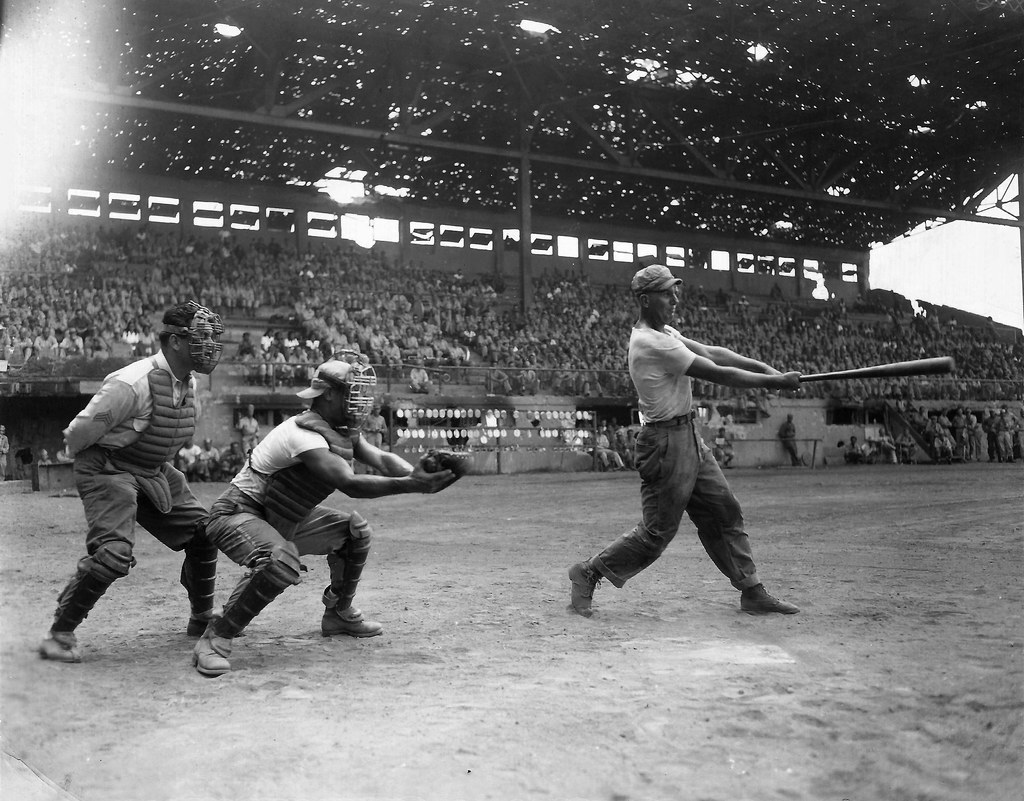
Once the Philippine Islands were secure, the military formed leagues and units fielded teams to compete during the more temperate months. Former Brooklyn Dodger pitcher Kirby Higbe formed team for Base-30 and named the club after his pre-war team. The Manila Dodgers club consisted of a handful of former major and minor leaguers along with soldiers who were top athletes prior to their Army service.
| Player | Position | Prior Baseball Experience |
|---|---|---|
| Vernon Bickford | P | Welch (MTNS) |
| Wally Borden | CF | LSU |
| Hal “Zig” Emery | 2B | (Property of Phillies) |
| Joe Garagiola | C | Columbus (AA) |
| Joe Ginsberg | C | Jamestown (PONY) |
| George Goodall | 2B | |
| Jim Hearn | P | Columbus (SALL) |
| Kirby Higbe | P/Mgr | Dodgers |
| Joe Janet | 3B | Tulsa (TL) |
| Frank LaManna | P/CF | Braves |
| Max Macon | 1B | Braves |
| Johnny Newman | RF | Jamestown (PONY) |
| Kent “Lefty” Peterson | P | Reds |
| Minor Scott | 3B | Chattanooga (SOUA) |
| Gerry Staley | P | Boise (PION) |
| John Stowe | LF | Knoxville/Mobile (SOUA) |
| Johnny Welaj | OF | Athletics |
| Ted Wendt | P | Janesville (WISL) |
| Early Wynn | SS | Senators |
The Dodgers were the team to beat throughout the season. The Base-30 team faced squads that also featured major leaguers. The Navy’s 432nd Port squad, led by Barney McCosky and Dom DiMaggio, the Marikina Mudhens and others competed against Higbe’s Manila nine though at the end of the season in early 1946, the Dodgers captured the Pacific Area crown.

This autographed artifact, inherited by Tim Cunningham from his father, is a 1945 Wilson Official American Association ball (bearing the stamped signature of league president, George Troutman). Bearing 15 autographs from the Manila Dodgers club.


While 11 signatures were identified and matched to names on the known Manila Dodgers roster, the other four have yet to be determined.


The Manila Dodgers, like most wartime service teams, had rosters that were ever-changing, especially as soldiers were being sent home to be discharged. The players whose autographs are undetermined may have been “regular joes” who finished out the season having backfilled for those who departed for their Army separation before the season’s end.


Kirby Higbe however the identification of the bottom signatures are undetermined (courtesy of Tim Cunningham).
Despite some fading of the ink and the discoloration of the hide, most of the autographs are still legible. Seeing Early Wynn and Joe Garagiola’s “John Hancocks” on the ball are truly special

Mr. Cunningham did not know how the ball came into his father’s possession, “I remember seeing it as a kid but I don’t know how he ended up with it,” Tim wrote in an email. “He was in the service between WWII and the Korean War and was never in the Philippines.”
“I actually wrote Early Wynn a letter back in the ’80s when I was a kid,” Cunningham continued, “and he wrote me back a one page note about it.”
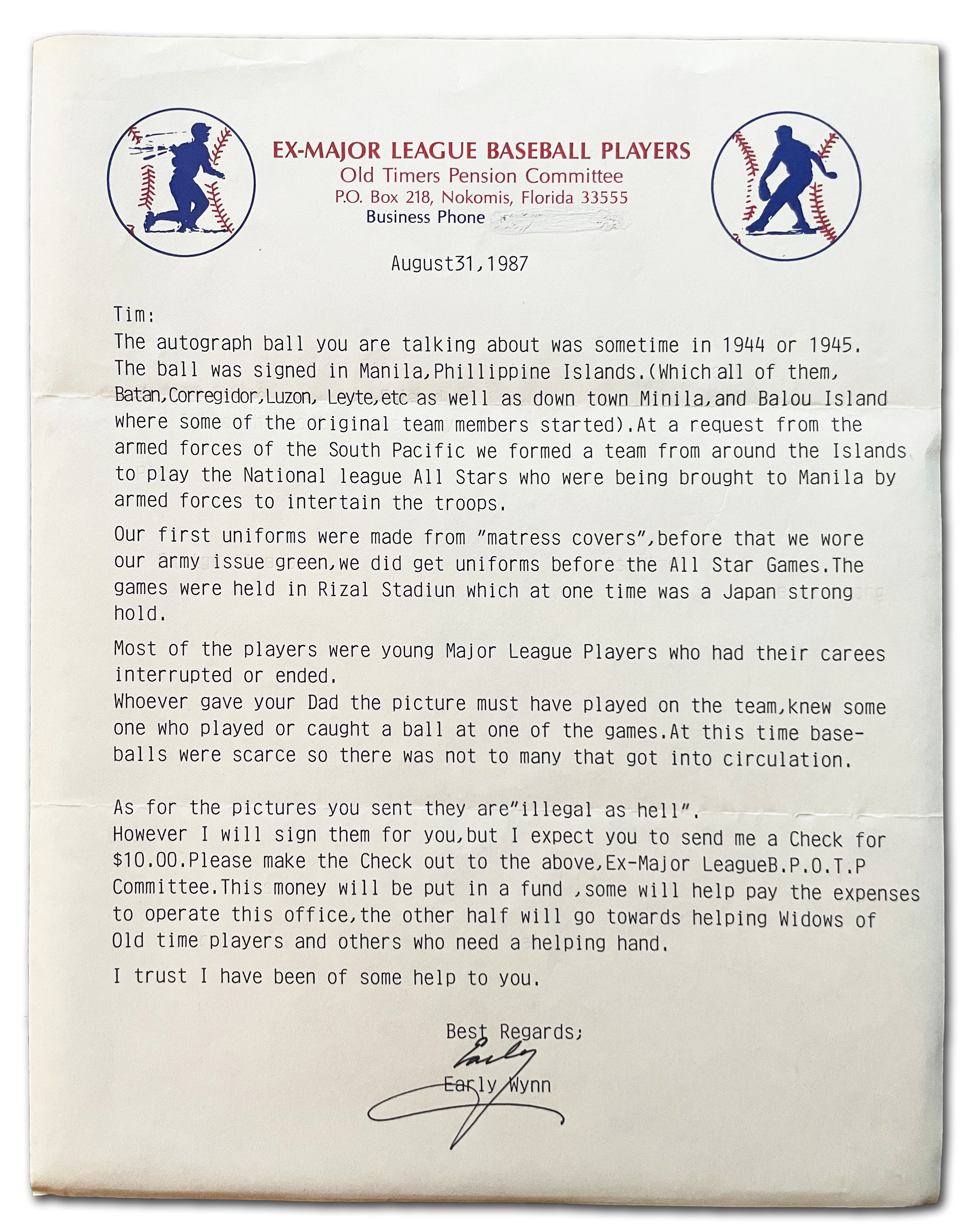
“The autograph (sic) ball you are talking about was sometime in 1944 or 1945, ” Early Wynn replied. “(sic)The ball was signed in Manila, Philippine Islands. (Which all of them, Batan, Corregidor, Luzon, Leyte, etc as well as down town Minila, and Balou Island where some of the original team members started).” Referring to the USO National League touring team’s impending arrival in for an early January series, Wynn continued, “(sic)At a request from the armed forces of the South Pacific we formed a team from around the Islands to play the National league All-Stars who were being brought to Manila by armed force to intertain the troops.”
Note: Early Wynn’s comment, “As for the pictures you sent they are ‘illegal as hell,’” he is referring to baseball cards manufactured by TCMA that Cunningham included in his request for autographs.
Related Stories and Artifacts
- A Combat and Baseball Story Uncovered: Discovery From a Lone Name on a Photo
- USO National League Stars vs Base-30 Manila Dodgers (Game 2)
- USO National League Stars vs Base-30 Manila Dodgers (Game 3)
- 1946 All-Navy “Seahawks” Jersey
This baseball is part of the Tim Cunningham collection. Images of the ball and Early Wynn letter were provided by Mr. Cunningham.

 Chevrons and Diamonds